Yes. One provider can be both a managed service provider (MSP) and a managed security service provider (MSSP), and for hospitals, clinics, and community banks with small IT teams, one accountable provider is usually the stronger model. It holds up only when security runs as a separate function inside that provider, with analysts watching around the clock and the authority to act.
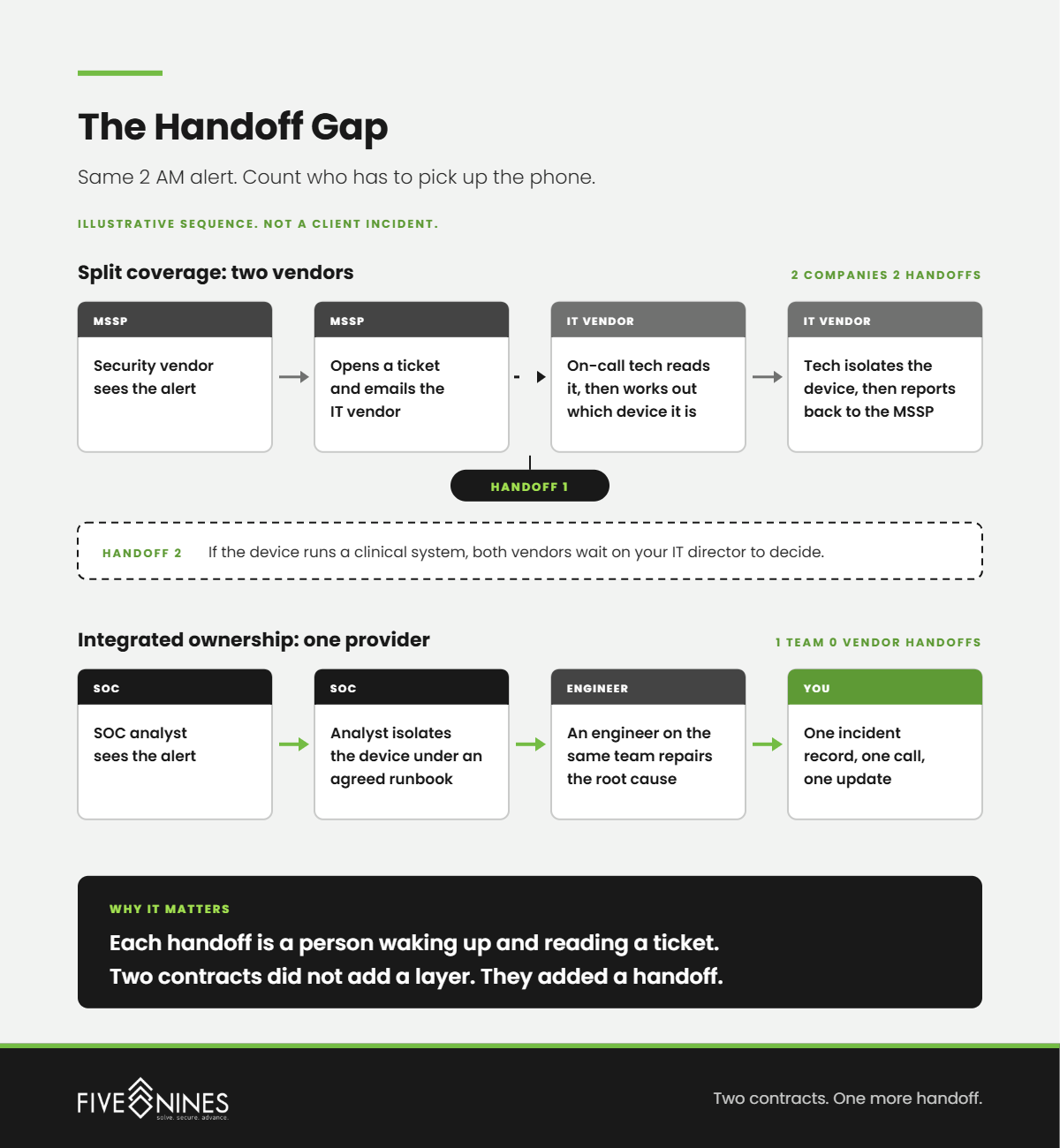
Here is what the other model looks like. At 2:40 AM, an endpoint alert fires on a workstation at the nurses' station. The security vendor sees it, opens a ticket, and emails the IT company that manages the network. The IT company's on-call technician reads it at 3:25, logs in, and starts working out which machine it is.
Nobody did anything wrong. Both contracts worked exactly as written.
Two contracts did not give that hospital two layers of protection. They gave it one more handoff.
The stakes are concrete. The IBM Cost of a Data Breach Report 2026, conducted by the Ponemon Institute, puts the average healthcare breach at $6.64 million, the highest of any industry studied. In the same study, as summarized by The HIPAA Journal, 26% of healthcare breaches traced back to IT failures rather than outside attackers. Operations and security are not two separate problems. Five Nines Technology Group builds around that fact.
What Is the Difference Between an MSP and an MSSP?
Short answer: An MSP keeps technology running: help desk, patching, devices, backups, and networks. An MSSP watches for threats and responds to them: 24/7 monitoring, detection, investigation, and containment. The MSP answers "Is it working?" The MSSP answers "Is it safe?" A hospital or community bank needs both answers every day.
The two roles grew up separately. MSPs replaced break/fix IT with flat-fee, proactive management. MSSPs grew out of the need to watch logs and endpoints around the clock, a job most mid-market organizations cannot staff themselves.
The line between them has blurred because the work overlaps. A missed patch is an IT task and a security hole at the same time.
|
Question |
MSP |
MSSP |
|---|---|---|
|
Core question |
Is it working? |
Is it safe? |
|
Typical services |
Help desk, patching, endpoint management, backups, vCIO planning |
24/7 SOC monitoring, EDR, managed SIEM, threat hunting, incident response |
|
Measured by |
Uptime, ticket resolution, user experience |
Time to detect, time to contain, threats stopped |
|
Failure looks like |
A slow EHR, a down server, a frustrated staff |
An attacker inside the network that nobody noticed |
Can One Company Do Both Well?
Short answer: Yes, when the security function is staffed and run separately from daily IT operations inside the same company. Five Nines runs managed IT and an in-house Security Operations Center (SOC) under one roof, so detection and remediation share one chain of accountability. The test is structure, not the label on the proposal.
Many providers call themselves both. Fewer have built both. The difference shows up in four places: dedicated security analysts, 24/7 coverage by people rather than email alerts, authority to contain a threat without waiting for a ticket, and an escalation path that runs outside the help desk queue.
If a security alert competes for attention with a password reset, the provider is an MSP with a security tool. That is a real service. It is not an MSSP.
What Leadership Misses
Buying a security tool through your IT provider is not the same as buying security operations. If nobody is assigned to act on the alert at 2 AM, you bought a dashboard, not a defense.
Is It a Conflict of Interest for Your IT Provider to Also Handle Security?
Short answer: It can be, if no one independent reviews the provider's own access. The fix is separation of duties: security monitoring that watches administrator activity, logs technicians cannot quietly edit, and periodic outside testing. A joint advisory led by CISA says MSP contracts should spell out who owns each security responsibility.
The "fox guarding the henhouse" concern is fair, and it deserves a direct answer. Your IT provider holds administrator access to nearly everything. In 2022, CISA, the NSA, the FBI, and partner agencies in four countries warned that attackers target MSPs specifically to reach their customers.
That makes the provider's own accounts part of your attack surface. A credible combined provider watches its own technicians' activity with the same rigor it applies to yours.
For hospitals, this is also a compliance question. The HIPAA Security Rule at 45 CFR 164.308(a)(1)(ii)(D) requires procedures to regularly review records of system activity, such as audit logs and access reports. Administrator logins belong in that review, including the provider's.
The Hidden Risk
The most powerful account in your environment usually belongs to your IT provider. Whoever runs your security should be watching that account as closely as any other.
What Actually Happens When IT and Security Are Split Between Two Vendors?
Short answer: Every confirmed threat requires a handoff. The security vendor detects it, then the IT vendor fixes it. That handoff adds time and translation at the moment speed matters most. IBM's 2026 research found breaches took an average of 247 days to identify and contain.
The split model is not wrong for everyone. An organization with a strong internal IT team can coordinate two vendors well, because its own people own the handoff.
Most hospitals and community banks in the 25 to 500 employee range do not have that layer. When the security vendor says "isolate this server" and the IT vendor says "that server runs the lab interface," someone has to make the call. Too often it is an IT director who is asleep, on vacation, or the only IT person in the building.
That is where vendor finger-pointing stops being an annoyance and becomes a risk.
How Can You Tell Which Kind of Provider You Actually Have?
Short answer: Use the Five Nines Security Ownership Model. It sorts providers into four stages based on one question: when a threat appears, who sees it, who can act, and how many handoffs sit between them? Most organizations can place themselves in under a minute.
The Five Nines Security Ownership Model
|
Stage |
What it is |
What it looks like on the floor |
Who acts at 2 AM |
What should trigger the next move |
|---|---|---|---|---|
|
1. IT With Security Tools |
Managed IT with antivirus, firewall, and backups installed and patched |
Alerts go to an inbox. Nobody reads it overnight. |
Nobody until morning |
A cyber insurance renewal asks about 24/7 monitoring or EDR |
|
2. Resold Security |
The IT provider resells a detection platform |
Security alerts land in the same queue as printer tickets |
An on-call technician, if someone pages them |
An alert sat unread, or a near miss nobody can explain |
|
3. Split Coverage |
A separate MSSP monitors. The MSP fixes. |
Two portals, two phone numbers, a handoff for every incident |
The MSSP sees it and calls the MSP |
An incident review shows time lost between vendors |
|
4. Integrated Ownership |
One provider with a distinct SOC that can contain threats, plus independent review of admin access |
One call, one incident record, containment and repair by one accountable team |
A SOC analyst contains it, an engineer repairs it, you get one update |
Ongoing: annual outside testing and quarterly review of access |
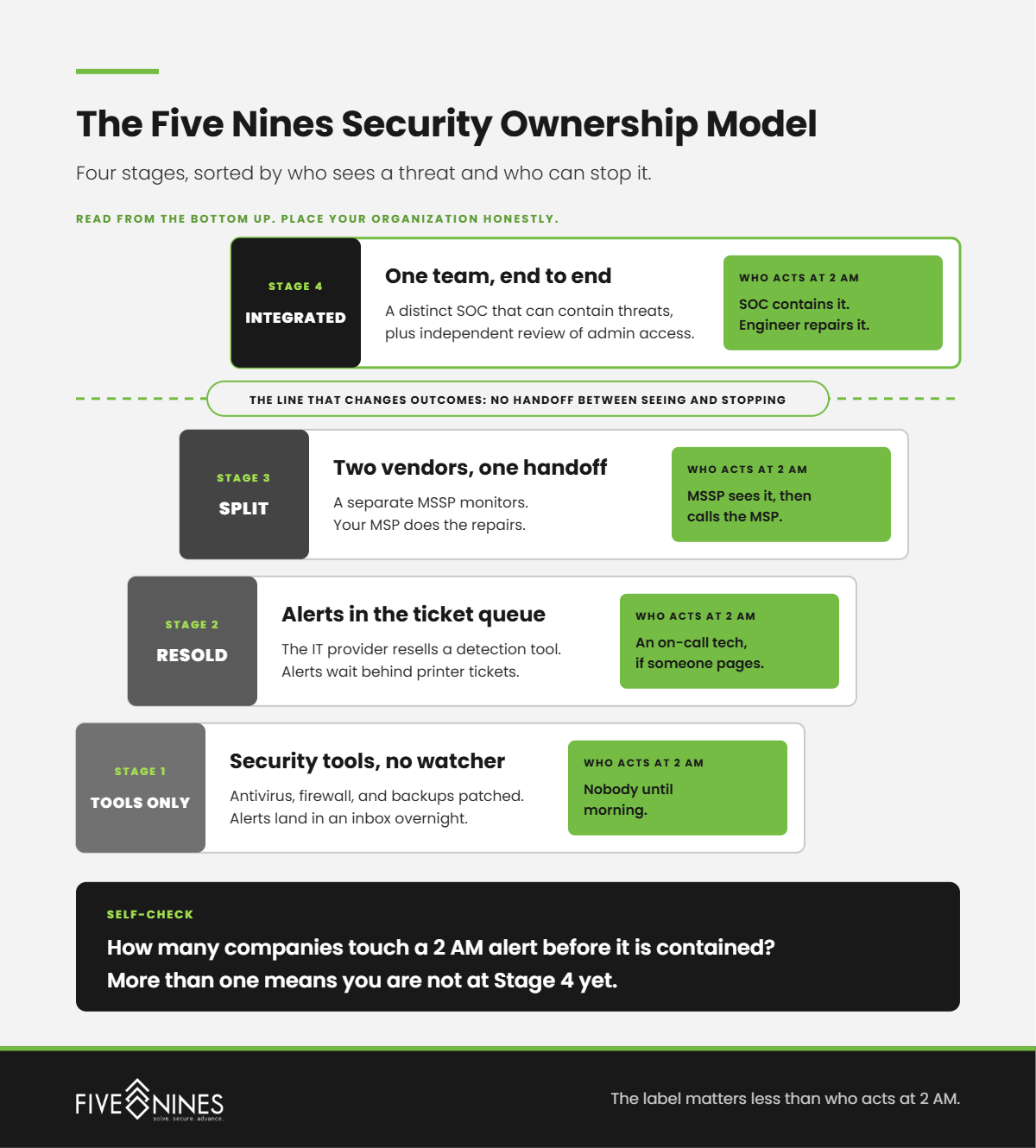
Stage 3 is where many careful organizations land, and it is a reasonable place to be. The gap is the handoff. Stage 4 closes it without giving up the separation that makes Stage 3 feel safe.
Five Nines Insight
Integration without separation is just consolidation. The goal is one accountable provider with two distinct jobs inside it: one team that keeps systems running and one that keeps watching everyone, including itself.
What Does Five Nines Usually Find When It Reviews Security Ownership?
Short answer: The gaps are rarely missing tools. Five Nines engineers more often find ownership gaps: alerts with no assigned responder, administrator accounts nobody reviews, and contracts that never say who isolates a compromised device. These are structure problems, and structure is fixable.
- Security alerts routed to the help desk queue. The detection tool works. The alert waits behind routine tickets until business hours.
- Shared administrator credentials. Several technicians use one admin login, so audit logs cannot show who did what.
- Nobody reviewing the provider's own access. Logs exist, but no one outside the IT team reads administrator activity.
- Contracts that name tools but not responsibilities. Both vendors assume the other one isolates the device.
- Security reports that count alerts but not actions. The monthly PDF shows volume, not what was contained or how fast.
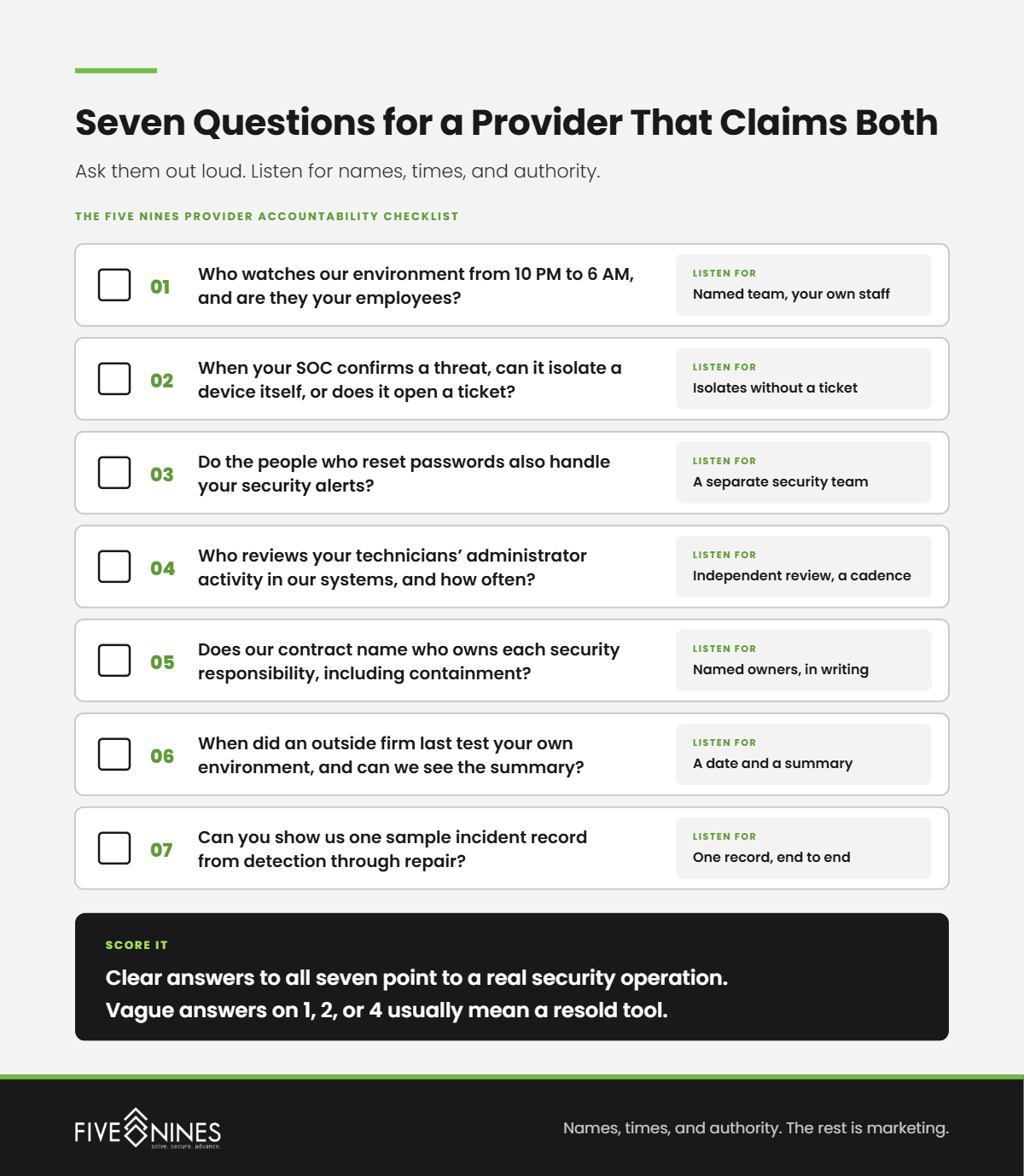
What Should You Ask a Provider That Claims to Be Both?
Short answer: Ask questions that expose structure rather than marketing. Who watches overnight, who can act without a ticket, and who reviews the provider's own access will tell you which stage of the Five Nines Security Ownership Model a provider actually operates in.
- Who watches our environment between 10 PM and 6 AM, and are they your employees?
- When your SOC confirms a threat, can it isolate a device on its own, or does it open a ticket for someone else?
- Are security alerts handled by the same people who reset passwords?
- Who reviews your technicians' administrator activity in our systems, and how often?
- Does our contract name who owns each security responsibility, including containment?
- When did an outside firm last test your own environment, and can we see the summary?
- Can you show us one sample incident record from detection through repair?
Who Actually Acts When Your Security Alert Fires at 2 AM?
If you had to think about that answer, you are not alone, and you are not stuck. Most organizations we talk with know their tools well. Fewer know their handoffs.
A Five Nines Security Ownership Assessment identifies:
- Where your security alerts go today and how long they wait
- Who holds administrator access and who reviews it
- Every handoff between vendors, from detection to repair
- Which stage of the Five Nines Security Ownership Model you operate in
- Gaps against the HIPAA requirement to regularly review system activity
You leave with a one-page ownership map showing who sees, who acts, and where the gaps are.
The question was never MSP or MSSP. It is whether anyone owns the whole chain.