Reactive IT vs Preventative IT: Making the Most of Your IT Investment
Reactive IT waits for things to break; preventative IT works to stop them from breaking in the first place. For a growing, regulated business, that...
Building an internal IT team sounds like the natural next step toward a growing business. You hire a few smart people, give them the right tools, and expect technology to run smoothly. But as your company grows, IT costs don’t rise in a straight, predictable line. They jump in spikes — every time you add headcount, launch a new system, or try to keep up with security and compliance demands.
Those spikes are the real cost of relying solely on an internal IT model. Once you dig beneath salary numbers and job titles, you see how quickly this approach becomes expensive, difficult to scale, and surprisingly fragile, especially in highly regulated industries where downtime and data risk aren’t an option.
In the early stage, most organizations start with one IT person. On the surface, it feels efficient: one salary, one person to handle “all things tech,” and a simple line item in your budget. In practice, that first hire is expensive long before they resolve their first ticket.
You’re paying for salary, benefits, tools, and training, plus the time it takes them to learn your environment, untangle old issues, and create even the most basic documentation. During that ramp up period, you’re investing heavily without yet seeing the stability you expected. And because you have only one IT person, your coverage is fragile from day one — if they’re out sick, on vacation, or leave the company, IT effectively stops.
As your team grows, so does the demand for IT. New employees need devices, accounts, secure remote access, and someone to call when things don’t work. Eventually, your lone IT person can’t keep up, and you add another hire — or two. Each time you do, you reset the clock.
You repeat the same cycle of recruiting, interviewing, onboarding, and training. You spend months getting each new person up to speed on your systems and norms. The cost of those hires is more than their salary; it includes the productivity lost while they ramp up and the inconsistency that comes with different people doing things in different ways. You’re spending more, but the experience for your end users may feel only marginally better.
Once your business reaches a certain size and complexity, generalists aren’t enough. Cloud platforms, cybersecurity, networking, and compliance demand deeper, specialized skills. That’s when you start looking for dedicated roles: a systems engineer, a security analyst, a network specialist, maybe even a project manager to coordinate it all.
These specialists command premium salaries and ongoing training. They often focus on narrow slices of your environment, which means you still need additional team members to cover day-to-day support. The result is a steep jump in your IT spending, often without a corresponding drop in risk. You are now funding a small internal IT department, but you may still see gaps in coverage, afterhours limitations, and bottlenecks when a single specialist becomes the only one who understands a critical system.
At the mature stage, leadership and management layers enter the picture. You might add an IT manager, director, or CIO to bring strategy and structure to your technology decisions. It’s a smart move in theory, but it significantly increases your cost structure.
Leadership doesn’t replace the need for technical staff. You still need people to answer tickets, managing infrastructure, and executing projects. Now, your IT budget covers a full hierarchy: frontline support, engineers, specialists, and leadership. Meanwhile, your internal cost curve keeps climbing, but the business may still experience the same frustrations — slow response times, inconsistent processes, and delayed initiatives — especially when the team is stretching thin or someone leaves.
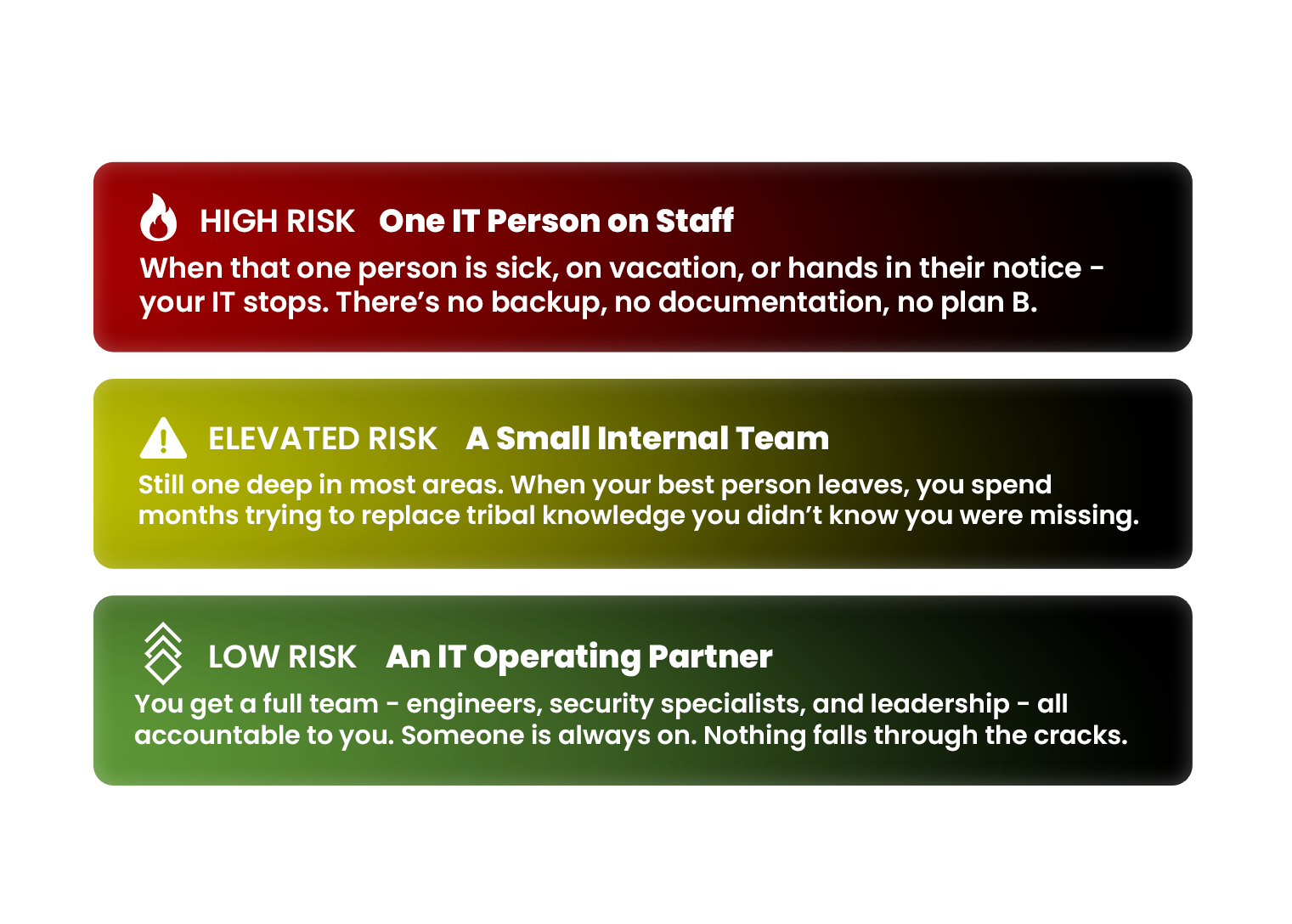
Cost is only half of the equation; risk is the part you feel most acutely when something breaks. With one IT person on staff, the risk is high by design. They hold most of the knowledge about your systems, tools, and workarounds in their head or inbox.
If that person is unavailable, sick, on vacation, or moving on, your IT operation stalls. Critical tasks get delayed; tickets pile up, and projects grind to a halt. There’s often no backup, no thorough documentation, and no clear plan B. The business is exposed, even though the budget line for “IT” looks small.
Adding a few more people lowers the immediate pressure but introduces a different challenge: silos. One person becomes “the network expert,” another “the Microsoft person,” and a third, the only one who understands your line of business application.
When any of them leave, you lose not only capacity but also the tribal knowledge they’ve built over time. It can take months for a new hire to reconstruct that understanding, and during that period, small issues can snowball into bigger problems. The risk is elevated because your processes and institutional knowledge are still concentrated inside a handful of individuals instead of being broadly shared and documented.
An IT Operating Partner is built to address both the cost spikes and the risk you carry with an internal only model. Instead of relying on a few individuals, you gain an entire team: frontline support engineers, infrastructure specialists, security experts, and strategic leadership — all accountable to your outcomes.
Coverage is continuous. Someone is always on, and no single person is a point of failure. Documentation and shared knowledge are baked into the model, not treated as a “nice to have.” You get the benefit of mature processes, proven tools, and a consistent experience for your end users, without having to build and maintain that operational engine on your own.
Every time your company grows, your internal IT costs jump, and they rarely come back down. You add people to solve immediate pain, but each hire permanently changes your cost structure and adds new management and risk considerations.
The real question isn’t whether you can afford an IT Operating Partner. It’s whether you can afford to keep scaling on a model that is expensive, unpredictable, and vulnerable to single points of failure. A partner like Five Nines gives you a full team, predictable pricing, and the peace of mind that comes from knowing your IT operations are built to support growth — not struggle to catch up with it.
Read more in our blog: In-House vs. IT-Partner: What Actually Works Better?

Reactive IT waits for things to break; preventative IT works to stop them from breaking in the first place. For a growing, regulated business, that...
.png)
Hiring more IT staff sounds like a straightforward way to solve technology problems — but it is not always the most effective or efficient path. In...
Technology shouldn’t hold your business back; it should give youthe confidence and stability to move forward. But for many growing organizations, IT...