How Do Managed IT Services Help Rural Clinics With Compliance?
Managed IT services help rural and specialty clinics with compliance by running the security controls HIPAA expects and documenting that work as it...
Skip the conference room. Walk the provider through five places in your hospital, ask the right question at each stop, and watch what they notice.
A rural hospital should ask an IT provider questions in the places where IT actually fails: how they would speed up a slow workstation at the nurses' station, who keeps the lab connected to the EHR, what they would change in the network closet, how they would stop a fake invoice in the business office, and what they would tell your board.
Most provider evaluations happen in a conference room. Someone presents slides, someone else asks about pricing, and everyone leaves with a brochure.
Try this instead. Hand the provider a visitor badge and walk them through your building.
The best IT interview does not happen in a conference room. It happens in your hallways.
A walk-through works because a rural hospital's IT problems are physical. They sit in a workstation that takes two minutes to log in, a closet with an unlabeled switch, and a business office inbox. A critical access hospital runs no more than 25 inpatient beds, which means the whole tour fits in half an hour. In that half hour, you will learn what a provider notices on its own. That is the thing you are actually hiring.
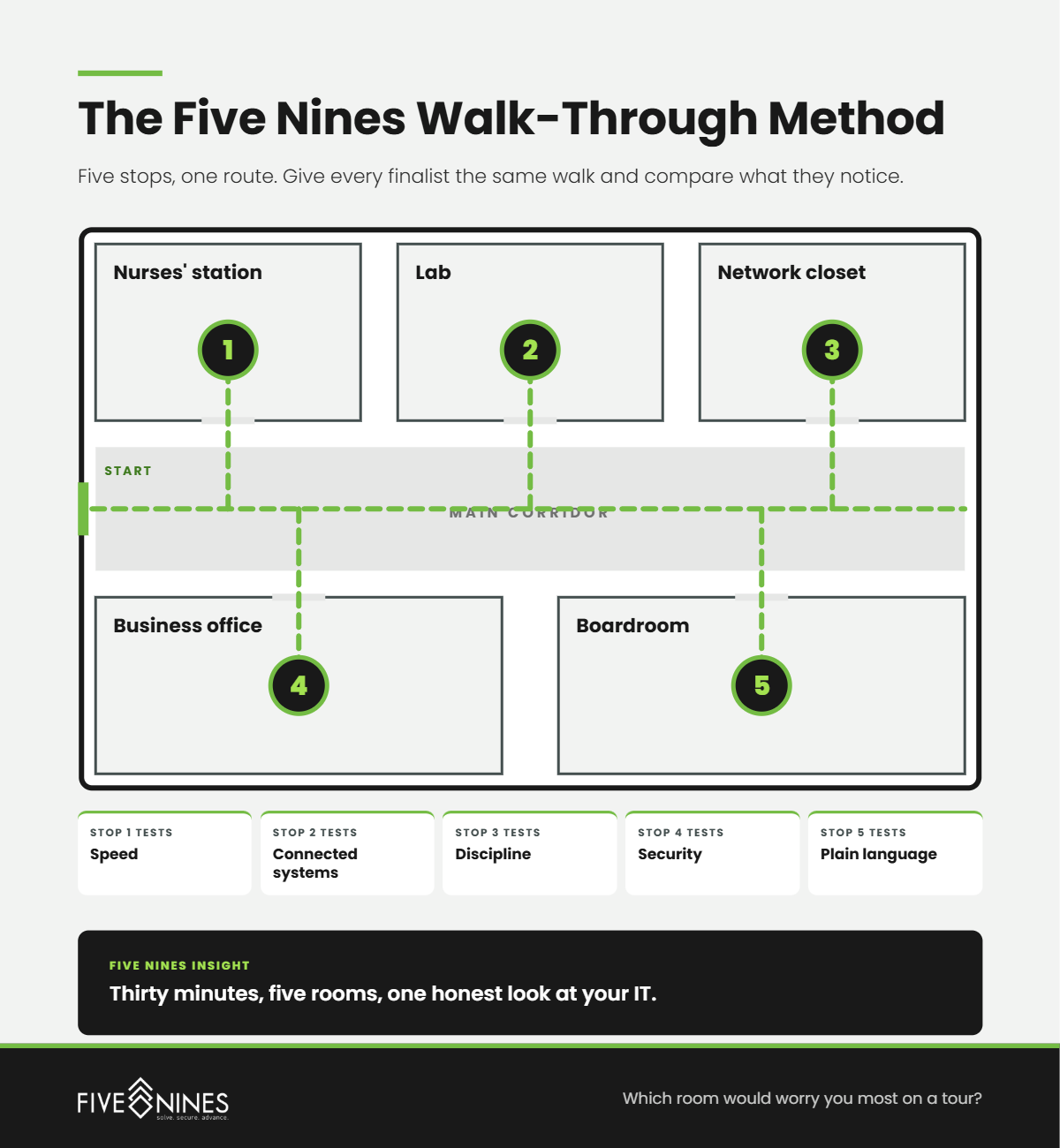
Short answer: A walk-through shows how a provider thinks when nobody hands it a script. Five Nines Technology Group recommends rural hospitals tour finalists through five stops, the nurses' station, the lab, the network closet, the business office, and the boardroom, because each one tests a different part of the job.
Sales presentations are rehearsed. Hallways are not. When a provider stands at your nurses' station and watches a nurse wait on a login, you find out whether they see a ticket or a patient delay.
Bring your IT person and one clinical leader. Give each finalist the same route. Take notes on two things at every stop: what they ask, and what they notice that you did not mention.
Short answer: Ask how they would make clinical workstations faster and more reliable. A good provider will want to time a login, ask how old the machines are, and ask whether nurses share accounts. Those questions show they connect workstation health to patient care.
Stand where the night nurse stands. Ask: "If this computer froze at 3 a.m., what would happen next?" Then let them answer without help.
Listen for specifics: remote access, replacement stock on site, and a named escalation path. Listen too for the questions they ask back. How many workstations are past five years old? Do staff share logins? Who replaces a dead badge reader?
The Hallway Test
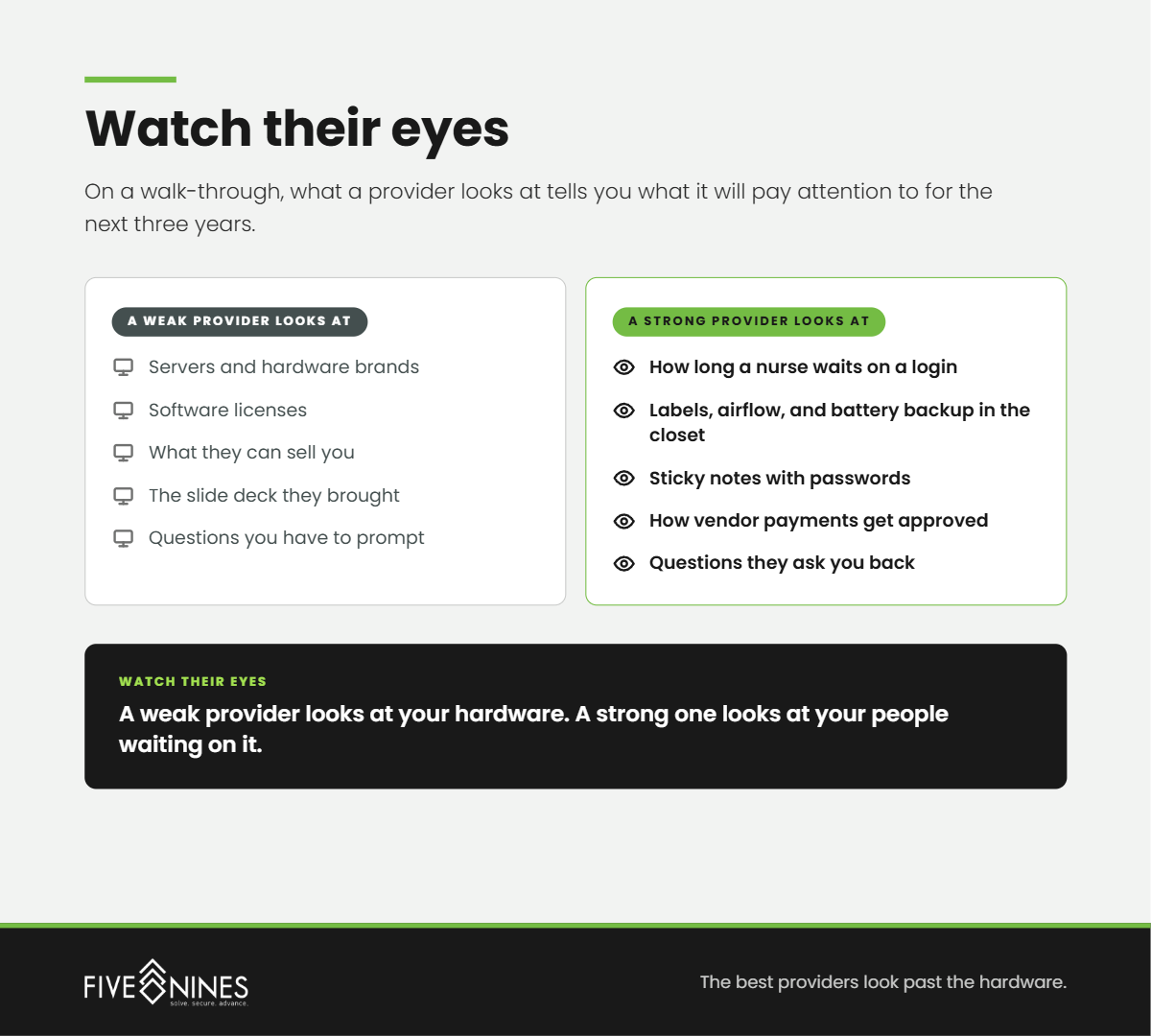
If a provider walks past a workstation that takes two minutes to log in and says nothing, it will walk past it for the next three years too.
Short answer: Ask the provider to explain, standing in the lab, who it calls when results stop flowing into the EHR. A rural hospital needs a provider that will open the vendor ticket and stay on the call, so lab staff are not relaying messages between companies.
The lab is where connected systems pile up: analyzers, label printers, interfaces, and sometimes a workstation running software nobody has updated in years. It is also where a quiet failure turns into a delayed result.
Ask which EHR platforms the provider supports today and whether it can act as your authorized contact with the vendor. Ask how it handles devices it cannot patch. Our EHR Accountability Map shows who owns each layer.
Short answer: Open the door and ask: "What would you fix first?" A strong provider will look at labeling, power backup, cooling, and documentation before it mentions any hardware it sells. If the first answer is a product, keep walking.
The network closet is the most honest room in the building. It shows years of decisions at once: cables nobody labeled, a backup battery nobody tested, a switch installed by a vendor who is long gone.
Ask where your network diagram lives. Ask how they would document this closet in the first 90 days, and who would own that documentation if you parted ways. Then ask when your backups were last restored, not just run.
Short answer: Ask how they would stop a convincing fake invoice or a changed bank account request from reaching the person who pays bills. Business email compromise cost U.S. organizations about $3 billion in reported losses in 2025, according to the FBI's Internet Crime Complaint Center, and the business office is where it lands.
Clinical systems get the attention. The business office gets the email. Billing, payroll, and vendor payments all run through a handful of inboxes, often in a small hospital with one person approving payments.
Ask the provider what it does about that in practice: multi-factor authentication, email filtering, and a payment verification habit for staff. Ask what your cyber insurer will require at renewal, and whether they can help you prove it.
Short answer: End the walk in the boardroom and ask the provider to summarize what it saw in three minutes, in plain language. A provider that can turn a 30-minute tour into clear priorities for a CEO and board is one that will run useful quarterly reviews.
Rural hospital boards are making hard calls. The Chartis Center for Rural Health's 2026 rural health state of the state found 41% of rural hospitals operating at a loss. Technology spending has to earn its place in that budget.
Ask: "What are the top three things you saw today, and what would each cost us if we did nothing?" Five Nines includes virtual CIO quarterly business reviews and IT budget planning in its managed services, so this is the conversation we expect to have every quarter.
Watch Their Eyes
On a walk-through, a weak provider looks at your hardware. A strong one looks at your people waiting on it.
Short answer: The Five Nines Walk-Through Method is a 30-minute route a rural hospital uses to evaluate IT providers. It covers five stops, the nurses' station, the lab, the network closet, the business office, and the boardroom, with one question to ask and one thing a strong provider should notice at each.
Print this table and carry it on every tour. Give each finalist the same route and the same questions so you can compare notes afterward.
| Stop | What to show them | The question to ask | What a strong provider notices on its own |
|---|---|---|---|
| 1. Nurses' station | A login at a clinical workstation | "If this froze at 3 a.m., what happens next?" | Login time, machine age, shared accounts |
| 2. Lab | An analyzer or interface workstation | "Who calls the EHR vendor when results stop flowing?" | Devices that cannot be patched, and who owns the interface |
| 3. Network closet | The open door | "What would you fix first?" | Labels, battery backup, cooling, and missing documentation |
| 4. Business office | The inbox that pays vendors | "How would you stop a fake invoice?" | Multi-factor authentication, email filtering, and payment verification habits |
| 5. Boardroom | Nothing. Ask for a summary. | "What are the top three things you saw?" | Priorities tied to cost and patient impact, not product names |
After the tours, compare finalists on one question: which provider noticed the most without being told?
Short answer: Five Nines engineers usually notice the small things that add up: aging workstations at clinical stations, unlabeled network closets, shared logins, devices running unsupported software, and payment approvals handled entirely by email. None of these appear in an IT inventory, and all of them show up on a walk.
You do not need a provider to find these. You need a provider that finds them without being asked.
If your current provider has never walked your building with you, you may not know what it would notice.
A Five Nines rural hospital site walk covers:
Your hallways already know what your IT needs. Bring someone who knows how to look.

Managed IT services help rural and specialty clinics with compliance by running the security controls HIPAA expects and documenting that work as it...
Why Security Operations Is a Capability Budget, Not a Tool Purchase A hospital CFO walking into the security operations decision is not buying a tool...
When a rural hospital loses internet access, it loses far more than email. Every system hosted outside the building stops: the cloud EHR,...