Which Managed IT Services for Healthcare Support EHR and HIPAA?
Managed IT services for healthcare work best when one accountable team owns everything between a clinician and the chart: the workstation, the login,...
The managed IT services that help a small business replace Dropbox with secure server storage are private cloud hosting, identity and access control, immutable backup with disaster recovery, and 24/7 security monitoring, delivered together by one accountable provider such as Five Nines Technology Group. New storage alone does not fix the problem. Control does.
Picture the front desk at a 40 person clinic. A referral folder was shared with a specialist's office years ago and never unshared. A former billing coordinator still has the desktop app on her personal laptop. Nobody can say for sure whether the patient forms folder is backed up or simply synced.
The files are all there. The app works fine. Nothing looks broken.
Most small businesses do not have a Dropbox problem. They have a custody problem.
Custody comes down to three questions leadership should be able to answer in under a minute: who owns this file, who can open it, and how fast can we get it back.
Short answer: Not by default. Dropbox business team plans include admin controls, and Dropbox will sign a HIPAA business associate agreement on eligible plans. The risk Five Nines sees is how small teams use it: personal accounts, links that never expire, and no one assigned to own the settings.
HHS is clear on the baseline. Its Guidance on HIPAA and Cloud Computing says a covered entity may store ePHI with a cloud provider only if a HIPAA-compliant business associate agreement is in place. A front desk coordinator syncing patient forms to a personal Dropbox account has no such agreement.
Shared platforms also carry risk you do not control. In its April 2024 Form 8-K filing, Dropbox disclosed that an attacker reached the Dropbox Sign production environment and accessed customer emails and usernames, plus API keys, OAuth tokens, and hashed passwords for some users. Dropbox reported no evidence that document contents were accessed and said the incident was limited to Dropbox Sign.
The lesson is not that Dropbox failed. It is that the only controls you can count on are the ones you own and can see.
The Hidden Risk
A shared link stays shared until someone turns it off. Most small businesses have never asked how many of theirs are still open.
Short answer: Secure server storage is four managed services working together: dedicated private cloud storage, identity and access control, immutable backup with disaster recovery, and 24/7 security monitoring. Five Nines Technology Group delivers all four from one team, so no single gap falls between vendors.
|
Service |
What it does |
What it fixes from the Dropbox setup |
|---|---|---|
|
Private cloud storage |
Dedicated compute and storage in Tier III+, SOC 2 Type II data centers, 99.999% uptime SLA, fixed monthly pricing |
Files live in a defined compliance boundary instead of on personal laptops and consumer accounts |
|
Identity and access control |
Company accounts with MFA, folder permissions by role, one-step offboarding |
Former employees and outside parties lose access the day they leave |
|
Immutable backup and disaster recovery |
Backups that cannot be altered or deleted, with defined recovery time and recovery point targets |
Deleted or encrypted files can be restored from a clean copy, not re-synced |
|
24/7 monitoring |
In-house SOC, endpoint detection and response, managed SIEM, dark web credential monitoring |
Unusual file activity and stolen logins get investigated in real time |
Not every organization needs a server. For some teams, governed Microsoft 365 file storage is the better fit, and an honest assessment should say so. The point is to choose storage after deciding who controls it, not before.
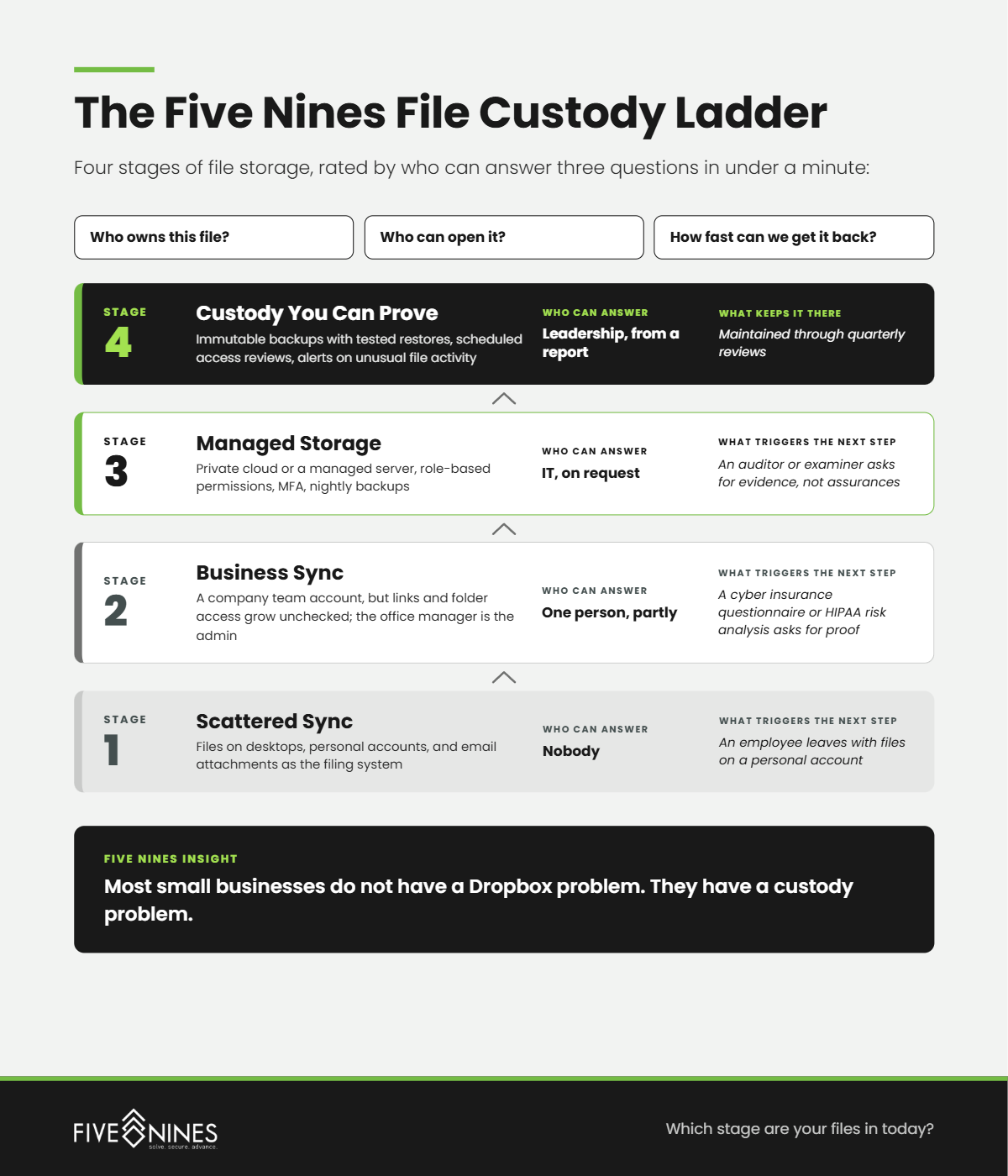
Short answer: The Five Nines File Custody Ladder rates file storage in four stages, from Scattered Sync to Custody You Can Prove. The stage depends on who can answer three questions: who owns a file, who can open it, and how fast it comes back.
The Five Nines File Custody Ladder
|
Stage |
What it looks like on the floor |
Who can answer the custody questions |
What usually triggers the next step |
|---|---|---|---|
|
1. Scattered Sync |
Files on desktops, personal Dropbox and Google accounts, email attachments as the filing system |
Nobody |
An employee leaves with files on a personal account |
|
2. Business Sync |
A company Dropbox team account, but links and folder access grow unchecked; the office manager is the admin |
One person, partly |
A cyber insurance questionnaire or HIPAA risk analysis asks for access controls and backup proof |
|
3. Managed Storage |
Files on private cloud or a managed server, role-based permissions, MFA, nightly backups |
IT, on request |
An auditor or examiner asks for evidence, not assurances |
|
4. Custody You Can Prove |
Immutable backups with tested restores, scheduled access reviews, alerts on unusual file activity, evidence ready on demand |
Leadership, from a report |
Maintained through quarterly reviews |
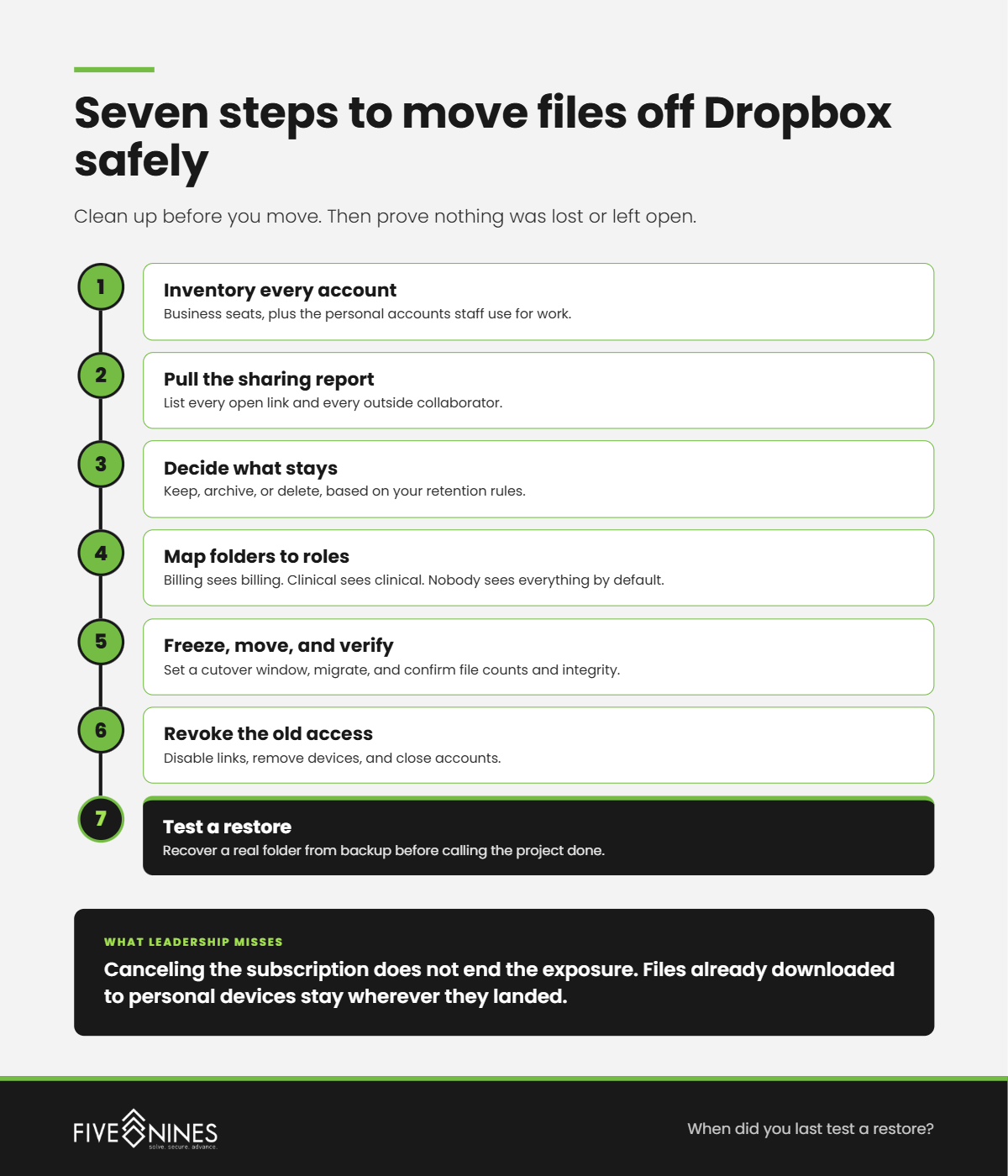
Short answer: Clean up before you move. A safe Dropbox migration inventories every account and shared link, decides what to keep, maps folders to roles, moves and verifies the files, then revokes old access. Five Nines runs the move as a defined project so nothing is lost or left open.
What Leadership Misses
Canceling the Dropbox subscription does not end the exposure. Files already downloaded to personal devices or shared with outside offices stay wherever they landed.
Short answer: The four services stay the same. What changes is the evidence the regulator wants. Community banks answer to GLBA safeguards requirements, and defense suppliers handling controlled unclassified information must meet CMMC and NIST SP 800-171 controls for where that data lives.
For a community bank or credit union, the question from examiners is whether customer information is protected and whether you can show it.
Short answer: Five Nines prices private cloud per resource or per workload each month, with management, backup, and disaster recovery included. Migration is billed as a one-time project. The real comparison is not storage cost per user; it is the cost of one unrecoverable folder or one failed audit.
Dropbox bills per seat. Private cloud bills for the capacity and workloads you run, with no egress fees or surprise charges. The better budgeting question is what your current setup would cost on its worst day.
Short answer: The storage is rarely the surprise. What Five Nines engineers look for first is access that outlived its purpose: old links, former staff, and personal accounts holding company files.
Short answer: Ask who owns each layer, where the data physically lives, how restores are tested, and what happens to the old access. A provider that answers clearly in one meeting can usually run the migration without surprises.
If you cannot answer that in a minute, you are not alone, and the fix is more straightforward than the problem feels.
The Five Nines File Custody Assessment identifies:
You leave with a custody map and a stage-by-stage migration plan, whether or not you choose Five Nines to run it.
The question was never which app holds your files. It is who answers for them.

Managed IT services for healthcare work best when one accountable team owns everything between a clinician and the chart: the workstation, the login,...
To compare managed IT services for healthcare data security, look past the feature list and ask each provider to prove four things: who watches your...
Your EHR going down during patient hours is not just an IT inconvenience. It delays diagnoses, pushes appointments into overtime, and erodes the...