How Do Managed IT Services Help Rural Clinics With Compliance?
Managed IT services help rural and specialty clinics with compliance by running the security controls HIPAA expects and documenting that work as it...
.png)
Growing healthcare organizations are best supported by an integrated set of managed IT services: a responsive help desk, endpoint and network management, managed security with a live security operations center (SOC), HIPAA compliance management, and tested backup and recovery, all guided by a virtual CIO. Which of those you need first depends on the growth threshold you are about to cross.
It usually starts small. The new nurse practitioner waits two days for an EHR login. The second clinic opens on a firewall nobody documented. The front desk at the new location texts the office manager's nephew because nobody knows who to call.
Growth does not break healthcare IT gradually. It breaks it at thresholds.
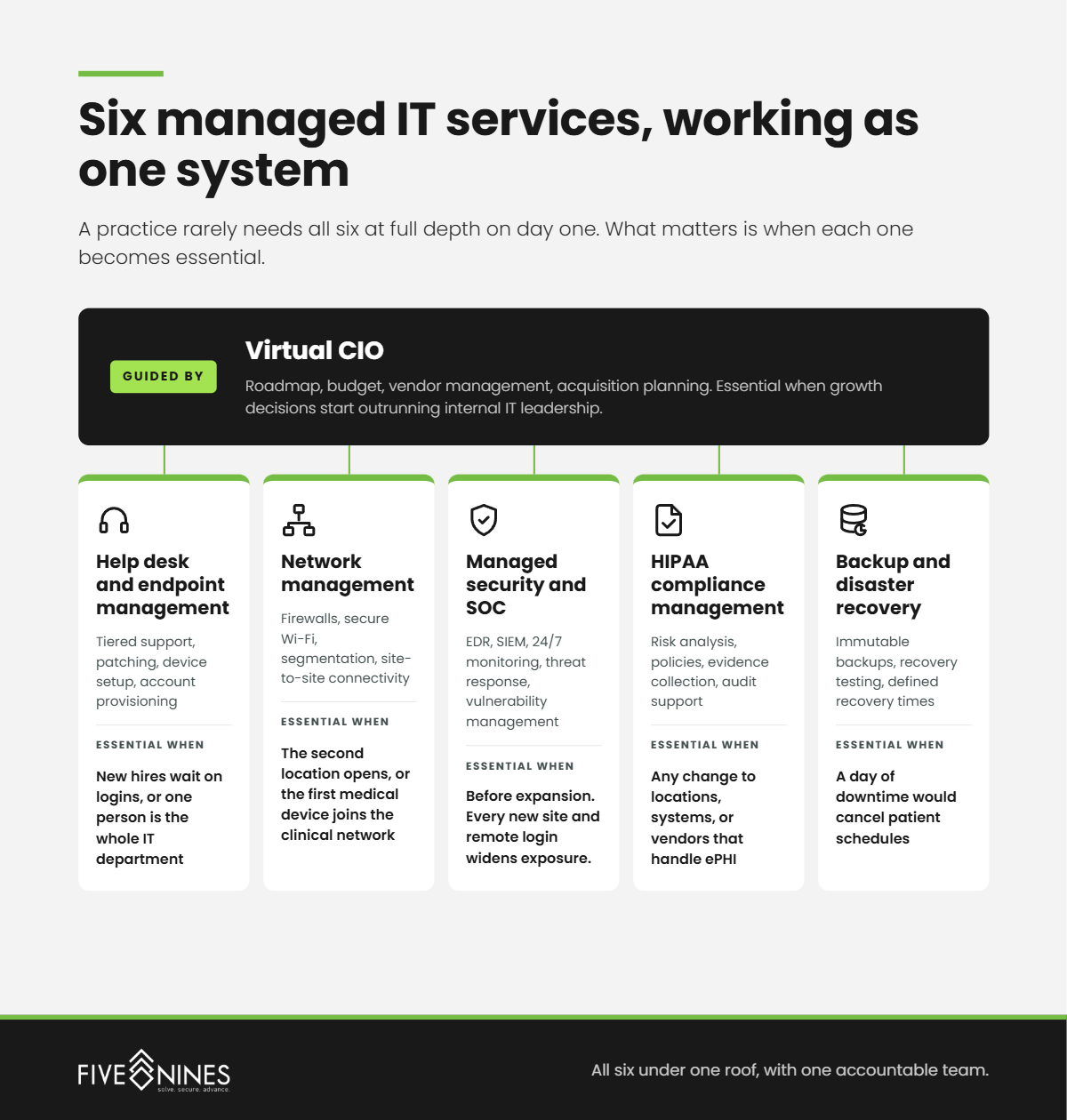
Short answer: A growing healthcare organization needs six managed IT services working as one system: help desk support, endpoint and network management, managed security with SOC monitoring, HIPAA compliance management, backup and disaster recovery, and virtual CIO planning. Five Nines Technology Group delivers all six under one roof for clinics and practices across the Midwest.
Most lists of healthcare IT services stop there. The more useful question is when each service becomes essential, because a practice rarely needs all six at full depth on day one.
|
Service |
What it covers |
When it becomes essential |
|---|---|---|
|
Help desk and endpoint management |
Tiered support, patching, device setup, account provisioning |
The day new hires wait on logins or one person is the whole IT department |
|
Network management |
Firewalls, secure Wi-Fi, segmentation, site-to-site connectivity |
The second location, or the first medical device on the clinical network |
|
Managed security and SOC |
EDR, SIEM, 24/7 monitoring, threat response, vulnerability management |
Before expansion, because every new site and remote login widens exposure |
|
HIPAA compliance management |
Risk analysis, policies, evidence collection, audit support |
Any change to locations, systems, or vendors that handle ePHI |
|
Backup and disaster recovery |
Immutable backups, recovery testing, defined recovery times |
When a day of downtime would cancel patient schedules |
|
Virtual CIO |
Roadmap, budget, vendor management, acquisition planning |
When growth decisions start outrunning internal IT leadership |
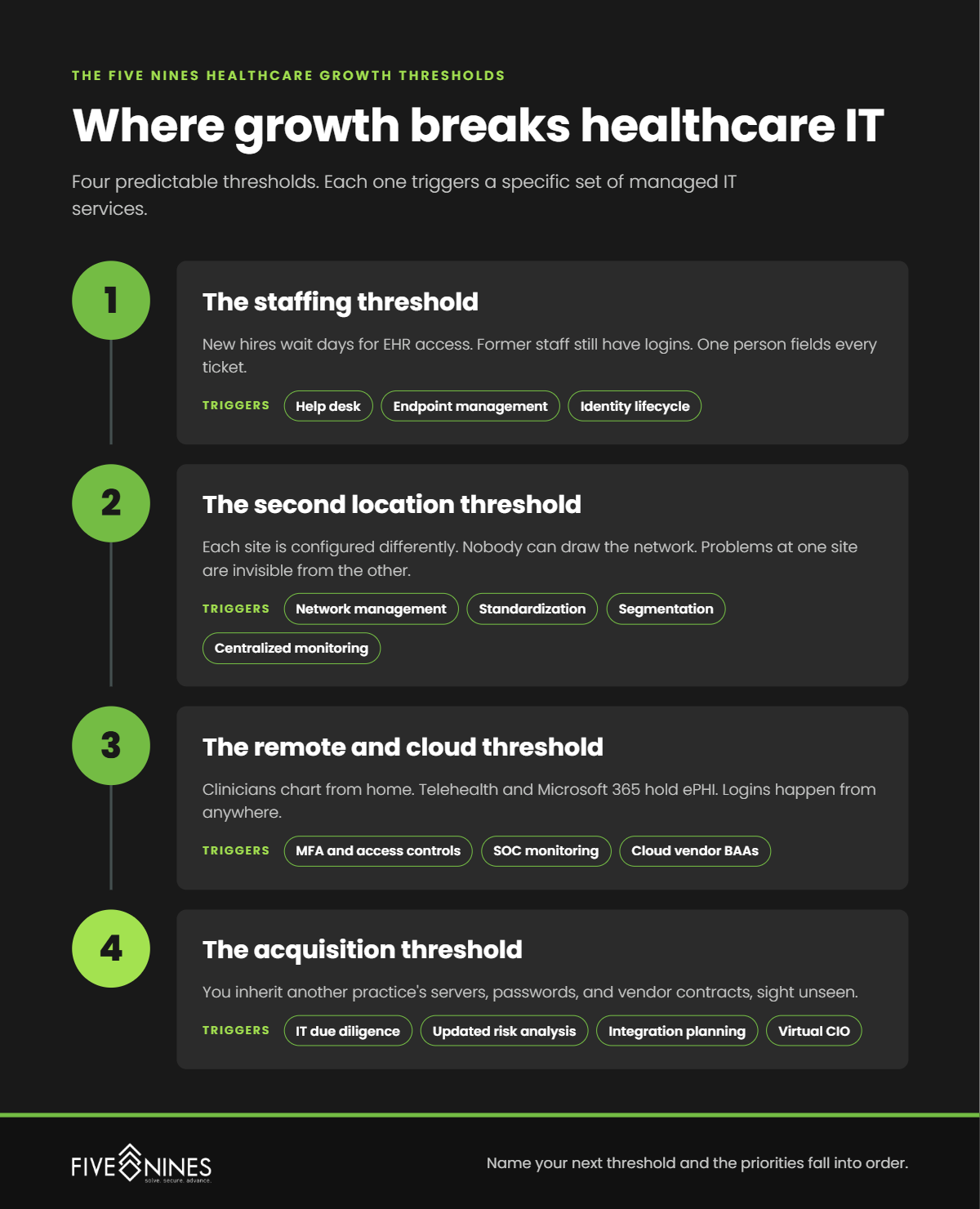
Short answer: Growth breaks healthcare IT at four predictable thresholds: outgrowing the in-house IT person, opening a second location, adding remote clinicians and cloud systems, and acquiring another practice. Five Nines calls these the Healthcare Growth Thresholds, and each one triggers a specific set of services.
Most practices think of IT as something that scales with headcount. It does not. It holds steady for a while, then fails all at once when the organization crosses a line it did not plan for.
The Five Nines Healthcare Growth Thresholds
|
Threshold |
What it looks like on the floor |
Services it triggers |
|---|---|---|
|
1. The staffing threshold |
New hires wait days for EHR access. Former staff still have logins. One person fields every ticket. |
Help desk, endpoint management, identity lifecycle (joiner, mover, leaver) |
|
2. The second location threshold |
Each site is configured differently. Nobody can draw the network. Problems at one site are invisible from the other. |
Network management, standardization, segmentation, centralized monitoring |
|
3. The remote and cloud threshold |
Clinicians chart from home. Telehealth and Microsoft 365 hold ePHI. Logins happen from anywhere. |
MFA and access controls, SOC monitoring, cloud vendor BAAs |
|
4. The acquisition threshold |
You inherit another practice's servers, passwords, and vendor contracts, sight unseen. |
IT due diligence, updated risk analysis, integration planning, vCIO |
Short answer: Managed security matters more with growth because every new location, device, user, and vendor connection is another way into systems holding ePHI. Five Nines operates an in-house SOC that watches client environments continuously, so detection keeps pace with expansion.
A single-site clinic with 20 workstations has a short list of doors. Add a second site, remote charting, a billing vendor with remote access, and a few imaging devices, and that list multiplies faster than anyone tracks it.
Antivirus catches known threats. Endpoint detection and response, paired with analysts watching the alerts, catches the unusual login at 2 a.m. and the account that suddenly starts copying files. Five Nines' SOC analysts are in-house, which means the people reviewing an alert can also call the clinic.
The Hidden Risk
Growth adds access faster than it adds oversight. The breach usually enters through the newest door, the one nobody has been watching yet.
Short answer: HIPAA compliance has to be updated every time the organization changes, because the Security Rule requires a risk analysis that reflects the current environment. New locations, cloud systems, and acquired practices all change where ePHI lives, and OCR's 2026 enforcement shows that outdated risk analysis is where penalties start.
All four of OCR's April 2026 ransomware settlements, totaling $1,165,000, pointed to the same gap: an incomplete or missing risk analysis, according to Nixon Peabody's summary. Ransomware was the incident. The risk analysis was the finding.
The proposed overhaul of the HIPAA Security Rule would raise the bar further with stricter requirements for asset inventories, encryption, and MFA. Its final action is now projected for July 2027 on the federal regulatory agenda, as reported by Fierce Healthcare. The current rule stays fully enforceable in the meantime, so waiting is not a compliance strategy.
What Leadership Misses
A risk analysis describes the organization on the day it was written. After the second clinic opens, it describes a practice that no longer exists.
Short answer: An integrated provider scales better because growth multiplies the handoffs between vendors, and every handoff is a place where accountability stalls. Five Nines puts help desk, infrastructure, private cloud, security, and compliance under one team, so a problem at a new clinic has one owner.
Picture the common setup: one company for the help desk, another for the firewall, the EHR vendor for the application, and a compliance consultant once a year. When charts load slowly at the new site, each vendor checks its own piece and reports that its piece is fine.
That is a visibility problem, and growth makes it worse. With one accountable team, the person investigating the slow chart can see the endpoint, the network, the server, and the security alerts at the same time.
For practices running servers on aging hardware, Five Nines' private cloud adds a fixed monthly cost and infrastructure inside a defined compliance boundary, backed by a 99.999% uptime SLA.
Short answer: In growing healthcare organizations, Five Nines engineers most often find access, documentation, and recovery gaps that formed quietly during expansion. None of them look urgent until an audit, an outage, or a breach exposes them.
Short answer: Ask a managed IT provider to prove it can operate a healthcare environment at your next size: who watches security alerts and when, how it onboards a new location, how it handles a Business Associate Agreement, and when it last ran a real recovery test.
How do you onboard a new clinic location, and how long does it take?
Which EHR and practice management platforms do you support today?
How do you handle account setup and removal when staff join, move, or leave?
How does your service map to the NIST Cybersecurity Framework 2.0?
The managed IT services that best support a growing healthcare organization are the ones matched to its next threshold, not its current headcount. Name the threshold you are approaching, whether that is a hiring push, a second clinic, remote charting, or an acquisition, and the priorities fall into order: security monitoring and access control first, an updated risk analysis next, then the help desk, network, and recovery services that keep each new site from becoming its own island.
If your practice is hiring faster than IT can keep up, or a second clinic is on the calendar, the gaps are already forming.
The Five Nines Healthcare IT Growth Assessment identifies:
Five Nines builds that stack as one system, so growth adds capacity instead of handoffs. The practices that scale smoothly are not the ones with the most IT. They are the ones that saw the threshold coming.
.png)
Managed IT services help rural and specialty clinics with compliance by running the security controls HIPAA expects and documenting that work as it...
To compare managed IT services for healthcare data security, look past the feature list and ask each provider to prove four things: who watches your...
.png)
Managed IT services for healthcare work best when one accountable team owns everything between a clinician and the chart: the workstation, the login,...