Your Staff Is Already Using AI. Now What?
If your staff is already using AI, the right move is direction, not a ban. Decide which tools are approved, which are off limits, and what...
Patient data ends up in unapproved AI tools when an employee trying to finish real work faster uploads it to a public AI platform the organization never cleared for protected health information. That is what happened at Johns Hopkins Bayview Medical Center in Baltimore, and it can happen in any hospital where staff have a browser and a busy afternoon.
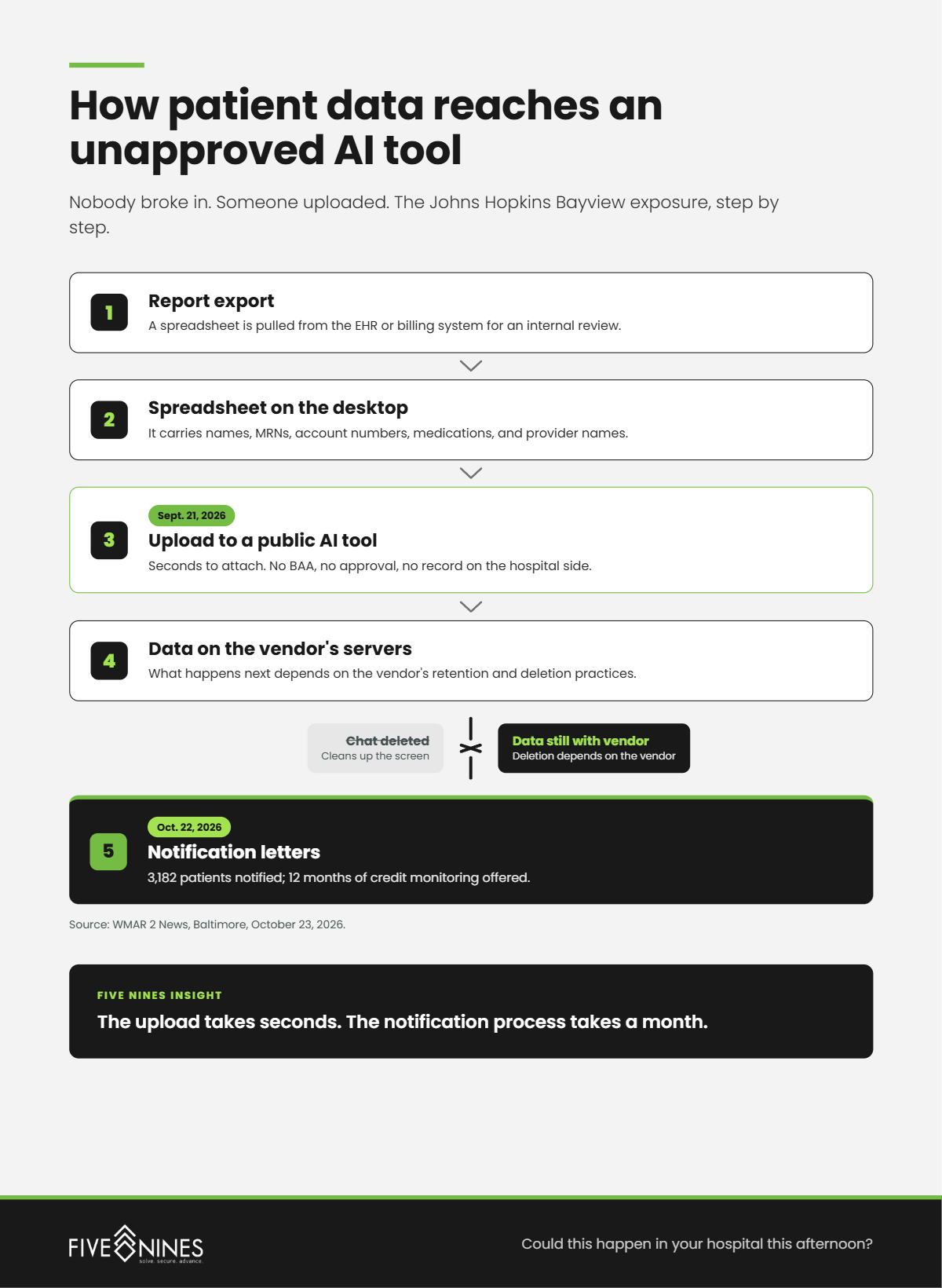
On Sept. 21, 2026, during an internal review, a Bayview staff member uploaded a spreadsheet of patient information to an outside AI tool. The file covered patients treated from May through September 2026 and included names, admission and treatment dates, medical record numbers, account numbers, departments, medications, and provider names, according to WMAR 2 News in Baltimore.
Nobody broke in. Someone uploaded.
That is the AI incident most hospital leaders are not planning for. A January 2026 survey from Wolters Kluwer Health found that 40% of healthcare professionals have encountered unauthorized AI tools at work, and nearly 20% admit to using them. This guide from Five Nines Technology Group, a managed IT and cybersecurity provider headquartered in Lincoln, Nebraska, explains how it happens, why security tools miss it, and how hospitals close the gap.
Short answer: A Johns Hopkins Bayview Medical Center employee uploaded a spreadsheet with health information for 3,182 patients to a public AI tool the hospital had not approved. The hospital found the problem the same day, Sept. 21, 2026, and began mailing notification letters on Oct. 22, 2026.
The exposed details reached well into the clinical record: medical record numbers, account numbers, treating department, medications given, and provider names. The hospital reported that Social Security numbers and financial account details were not included.
The response followed a familiar playbook. The employee deleted the prompt, the conversation thread, and the file from the tool's history. Bayview asked the AI company to delete the data, opened an investigation, and offered affected patients 12 months of credit monitoring through Experian IdentityWorks.
Bayview also said it is tightening limits on unapproved apps and AI tools and retraining staff on which tools are approved. Notice what that step tells every other hospital: the approved list and the training are the fix.
Short answer: It can be. Under HHS guidance on HIPAA and cloud computing, a cloud vendor that stores or processes electronic protected health information for a hospital is a business associate and needs a signed business associate agreement (BAA). A public AI tool with no BAA is not a cleared destination for patient data.
The U.S. Department of Health and Human Services Office for Civil Rights spells out the rule plainly. A covered entity may use a cloud service for ePHI only after it signs a HIPAA-compliant BAA with that provider and otherwise follows the HIPAA Rules.
When PHI lands somewhere it should not, the hospital's privacy officer has to work through a breach risk assessment and a notification decision. Five Nines is not a law firm, and every incident needs counsel. The operational lesson is simpler: if staff do not know which AI tools have a BAA behind them, every upload is a guess.
Short answer: Most staff use unapproved AI tools to work faster, not to cut corners on privacy. Wolters Kluwer Health found that nearly 20% of healthcare professionals admit to using unauthorized AI tools. When the approved path is slow or missing, people take the fast one.
The real issue isn't rogue employees. It's a productivity problem wearing a security costume.
Look at where the Bayview upload happened: during an internal review. Someone had a spreadsheet, a question, and a tool that could answer it in seconds. Nothing about that moment felt like a data breach to the person doing it.
That is why a memo that says "do not use AI" rarely holds. Staff who need speed will find a tool. Leadership's real choice is whether that tool is one they approved, can see, and have a BAA behind.
Five Nines Insight
A ban without an approved alternative does not stop AI use. It stops you from seeing it.
Short answer: Most hospital security tools are built to stop attackers getting in. An employee uploading a file to a well-known AI website looks like ordinary browsing. Catching it takes a written policy, an approved tool list, trained staff, and technical controls set up for AI destinations specifically.
Endpoint detection, firewalls, and 24/7 security monitoring are designed to find malicious activity. A clinician opening a popular AI site and attaching a spreadsheet is not malicious. It is a legitimate user, on a legitimate device, visiting a legitimate website.
That gap closes in layers. Training tells people where the line is. An approved tool list gives them somewhere safe to go. Web filtering and data loss controls can block or flag uploads to unapproved AI sites.
The Hidden Risk
Deleting the chat thread cleans up the screen. It does not prove where the data went.
Once a file reaches an outside vendor, what happens next depends on that vendor's retention settings and its willingness to delete on request. Bayview had to ask. No hospital wants to be the one asking.
Short answer: The Five Nines AI Governance Ladder sorts hospitals into four stages by how AI use is controlled on the floor. Most of the risk sits in the first two stages, where AI use is either invisible or banned on paper with no approved alternative.
The Five Nines AI Governance Ladder
|
Stage |
What it looks like on the floor |
When someone uploads PHI |
What moves you up |
|---|---|---|---|
|
1. Unaware |
No AI policy. Staff use personal AI accounts on work computers. Leadership assumes nobody does. |
Nobody knows until a patient, auditor, or reporter asks. |
Find out which AI tools staff already use. |
|
2. Banned on Paper |
A handbook line or email says not to use AI. No approved tool, no training, no follow-up. |
It happens anyway, quietly. Staff stop mentioning it. |
Publish an approved and banned tool list with at least one sanctioned option. |
|
3. Approved Path |
Approved tools under a signed BAA. Written acceptable use policy with staff sign-off. Live training for leaders and staff. |
Staff know where the line is and have a safe tool on the other side of it. |
Add recurring training, new-hire onboarding, and controls on unapproved AI sites. |
|
4. Governed |
Policy and tool list updated as tools change. New hires trained in their first month. Uploads to unapproved sites blocked or flagged. First-hour response written down. |
Blocked or caught fast, with a documented response. |
Review quarterly alongside the HIPAA security risk analysis. |
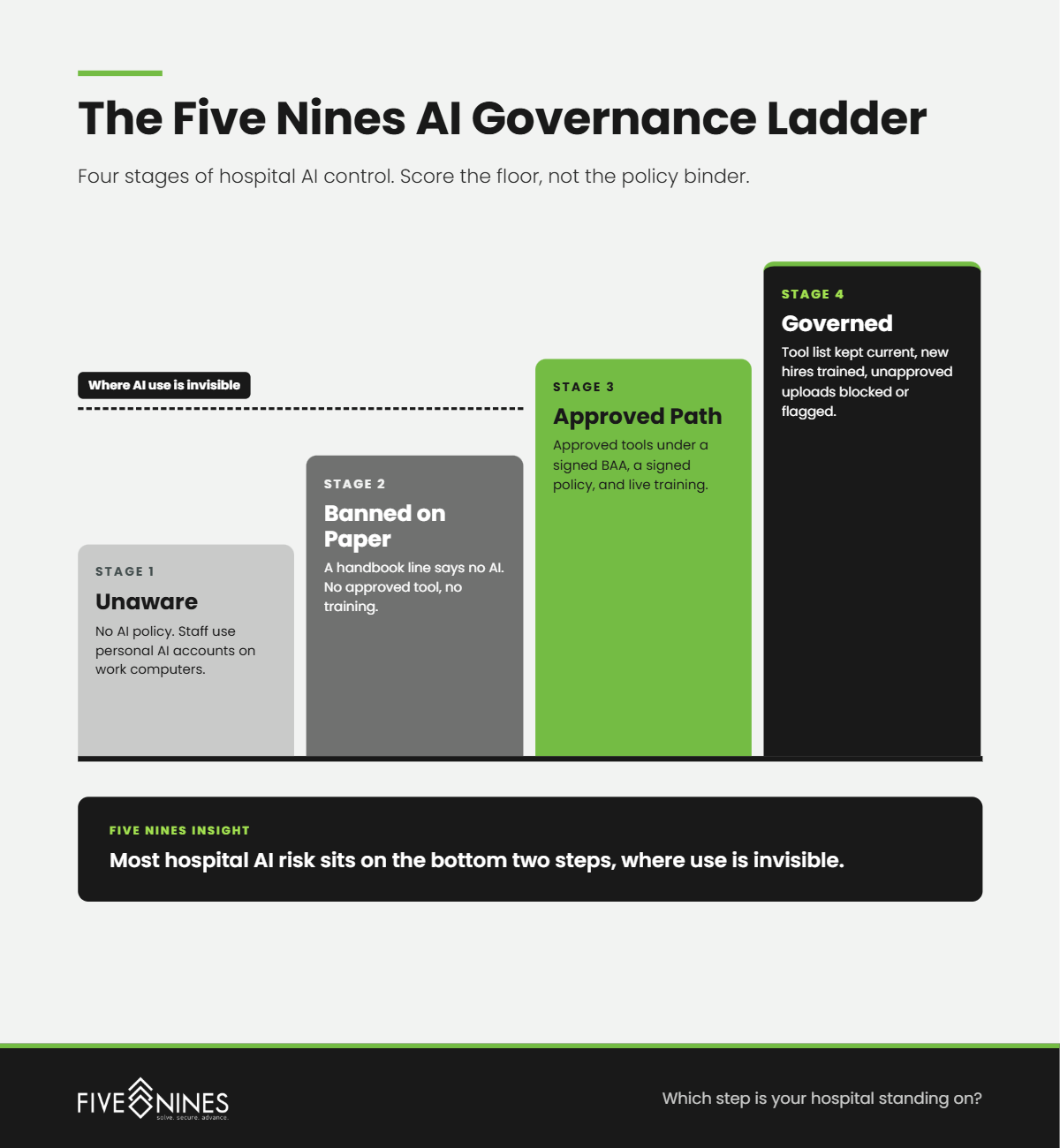
Score your hospital on the row that describes your floor, not your policy binder. The steps Bayview announced, limits on unapproved tools and retraining on approved ones, are Stage 3 work. The goal is to get there before the letters go out.
Short answer: When Five Nines reviews AI use in a healthcare organization, the warning signs are usually ordinary: personal AI accounts on work browsers, spreadsheets carrying more PHI than the task needs, and a policy nobody sees at the moment it matters.
Your most likely AI incident will not come from an attacker. It will come from one of your most efficient employees on a busy afternoon.
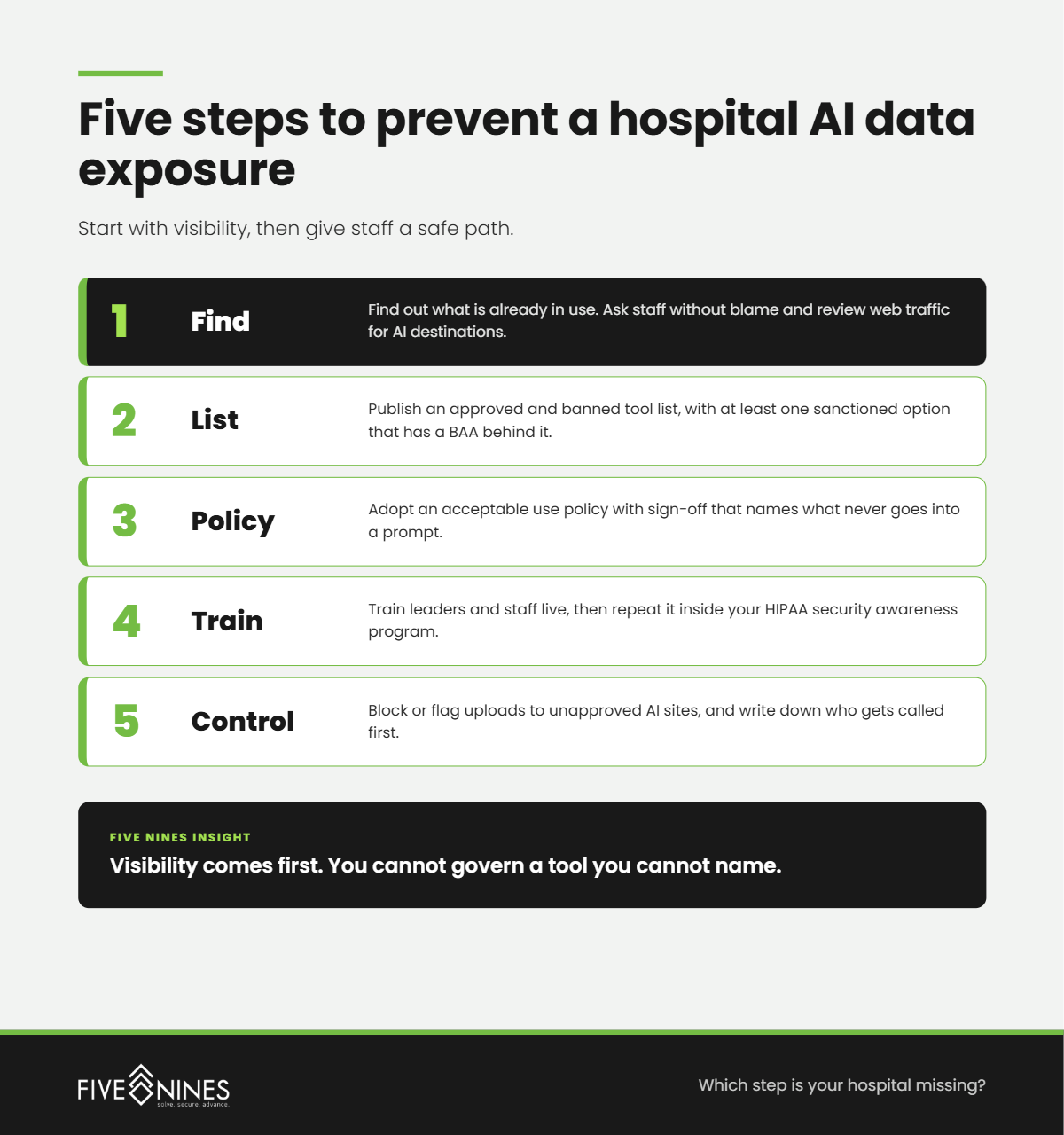
Short answer: Start with visibility, then give staff a safe path. Five Nines recommends five steps: find current AI use, publish an approved tool list, adopt a signed acceptable use policy, train every employee on a schedule, and add technical controls on unapproved AI sites.
Five Nines builds and maintains HIPAA compliance programs for healthcare organizations, including gap assessments, policy creation, security awareness training, and the evidence auditors ask for. For existing Five Nines healthcare partners, NineGuard Health adds AI training for leaders and staff, an acceptable use policy drafted and adopted with sign-off, and a published approved and banned tool list.
Short answer: Ask your IT provider six questions: which AI tools staff use now, which approved tools have a BAA, whether unapproved uploads can be blocked, whether training covers prompts, who responds first to an AI exposure, and how AI shows up in your HIPAA risk analysis.
If the honest answer is "I'm not sure," you are not alone, and you are not covered.
A Five Nines AI Exposure Review identifies:
You leave with your stage on the Five Nines AI Governance Ladder and a prioritized plan to reach Stage 3
The goal isn't to keep AI out of your hospital. It's to make the safe path the easy one.

If your staff is already using AI, the right move is direction, not a ban. Decide which tools are approved, which are off limits, and what...
Managed IT services for healthcare work best when one accountable team owns everything between a clinician and the chart: the workstation, the login,...
The managed IT services that help a small business replace Dropbox with secure server storage are private cloud hosting, identity and access control,...