Which Managed IT Services for Healthcare Support EHR and HIPAA?
Managed IT services for healthcare work best when one accountable team owns everything between a clinician and the chart: the workstation, the login,...
When a rural hospital loses internet access, it loses far more than email. Every system hosted outside the building stops: the cloud EHR, e-prescribing, lab and imaging interfaces, teleradiology reads, telehealth visits, and often the phones. Staff move to paper downtime procedures, and a backlog starts building that someone will have to re-enter later.
Picture a Tuesday afternoon at a 25-bed critical access hospital. A road crew replacing a culvert two miles out of town clips a fiber line. In the ER, a CT scan is finished, but the images have nowhere to go, because the radiologist reading them is 200 miles away. The nurse can't pull a medication history. The pharmacy can't send the e-script. The front desk phone is silent, because it rides the same line.
Every server in the building is still running.
The EHR didn't go down. The road to it did.
This is the side of downtime that rarely reaches a board report. Rural hospitals moved their core systems to hosted and cloud platforms for good reasons: cost, security, and access to vendors they could never staff locally. That move quietly turned a single strand of fiber into a clinical system. When a Lumen outage hit Port Angeles, Washington, in November 2023, Olympic Medical Center's electronic medical records were offline for nearly 36 hours, the Sequim Gazette reported.
Short answer: Anything hosted outside the building stops at once. Five Nines Technology Group sees the same pattern in rural healthcare: the cloud EHR, e-prescribing, imaging reads, lab interfaces, telehealth, and internet-based phones usually all ride one connection, so a single cut takes out clinical, communication, and business systems together.
Most leaders picture the EHR when they think about internet loss. The EHR is only the first domino. Here is what typically depends on that one connection.
|
System |
What happens when the link drops |
Who feels it first |
|---|---|---|
|
Hosted or cloud EHR |
Charts, orders, and the medication record are unreachable beyond printed or local downtime copies |
Nurses, providers, pharmacy |
|
E-prescribing |
Prescriptions move to paper or phone, if the phones work |
Pharmacy, discharging providers |
|
Teleradiology and imaging |
Completed scans can't reach the remote radiologist |
ER physician, patient |
|
Lab interfaces |
Send-out results stop arriving electronically |
Lab, ordering providers |
|
VoIP phones and fax |
Inbound calls, referrals, and faxed orders stop |
Front desk, transfer coordination |
|
Telehealth and tele-specialty consults |
Remote specialists can't see the patient |
ER, inpatient team |
The phones are the item leaders most often miss. When a construction crew in Cortez, Colorado, cut a fiber line, Southwest Memorial Hospital could not receive inbound calls, emails, or faxes, and 911 lines went down across several surrounding counties, according to the Durango Herald. The hospital's IT coordinator credited its disaster plan, and still described the day as a nightmare.
Short answer: Rural hospitals usually have fewer carriers, longer single routes out of town, and backup options that share the same physical path. An urban hospital may have three providers on different streets. A critical access hospital may have one fiber route along one highway, so one cut isolates the entire campus.
Geography does the damage. The fiber serving a small town often follows a single road or rail line for miles before it reaches a larger network. Every mile is a mile where a farm implement, a road crew, or a storm can sever it.
The backup can be just as fragile. In Whitehorse, Yukon, both of NorthwesTel's fiber lines south were cut, and the microwave backup was too slow to send head CT scans to radiologists in Calgary, Yukon News reported. ER doctors read the scans without a radiologist's help that night. The hospital had a backup. It just couldn't carry clinical work.
The fix is real and it has precedent close to home. Sidney Regional Medical Center in the Nebraska panhandle told Healthcare IT News that under its previous internet vendor it rarely went a week without some downtime, and that moving to redundant fiber routes all but eliminated it.
The Hidden Risk
A backup circuit that leaves the building in the same conduit as the primary is not a backup. It is a second wire waiting for the same backhoe.
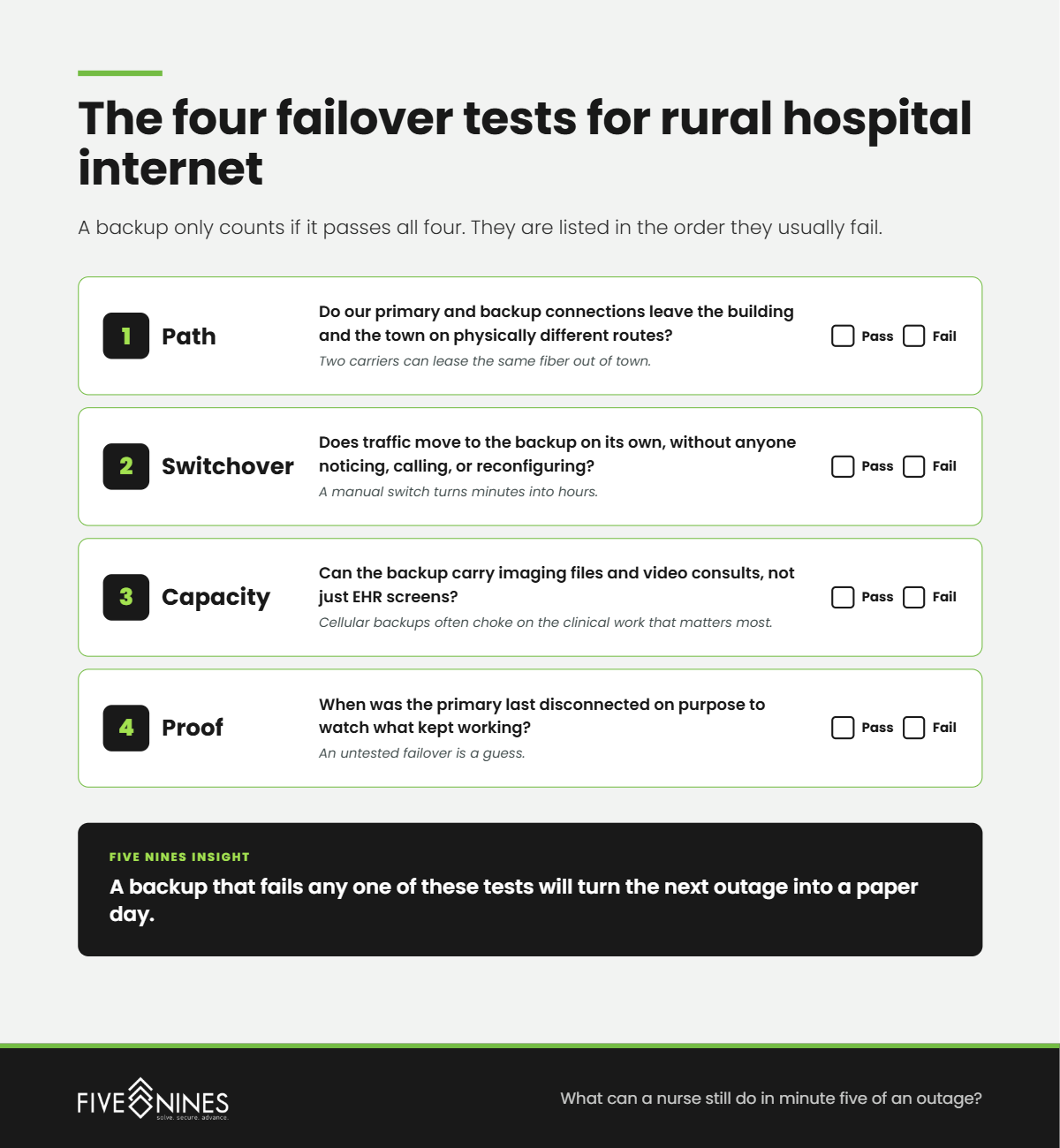
Short answer: Only if it passes four tests. The backup must take a physically different route, switch over automatically, carry enough bandwidth for clinical work, and have been tested under real conditions. In Five Nines reviews, rural backups commonly pass only one or two of these, which is why outages still become paper days.
The four tests, in the order they usually fail:
The question that matters is not whether a backup exists. It is what a nurse can still do in minute five of an outage.
What Leadership Misses
Uptime reports measure whether servers are running. They don't measure whether a nurse on the floor can reach the chart.
Short answer: It looks like an outage nobody on the floor notices. The Five Nines Rural Connectivity Resilience Model sorts hospitals into four stages, from a single connection where any cut means paper charts to a tested, diverse setup where an outage becomes an IT ticket instead of a clinical event.
The Five Nines Rural Connectivity Resilience Model
|
Stage |
What's in place |
What it looks like on the floor |
What moves you up |
|---|---|---|---|
|
1. Single Thread |
One carrier, one route out of town |
Every cut is a full paper day |
Add a second connection |
|
2. Backup on Paper |
A second circuit, but on a shared path or a manual switch |
Staff call IT, IT calls the carrier, recovery takes hours |
Map the physical routes and automate failover |
|
3. Diverse and Automatic |
Separate routes, different media (fiber plus fixed wireless, cellular, or satellite), automatic failover with EHR and phone traffic prioritized |
Staff notice slowness, not stoppage |
Test it on purpose, on a schedule |
|
4. Rehearsed Resilience |
Stage 3, plus scheduled failover tests, refreshed local downtime copies, and a written carrier escalation path with circuit IDs |
An outage is a ticket, not an event |
Hold the line through staff and vendor turnover |
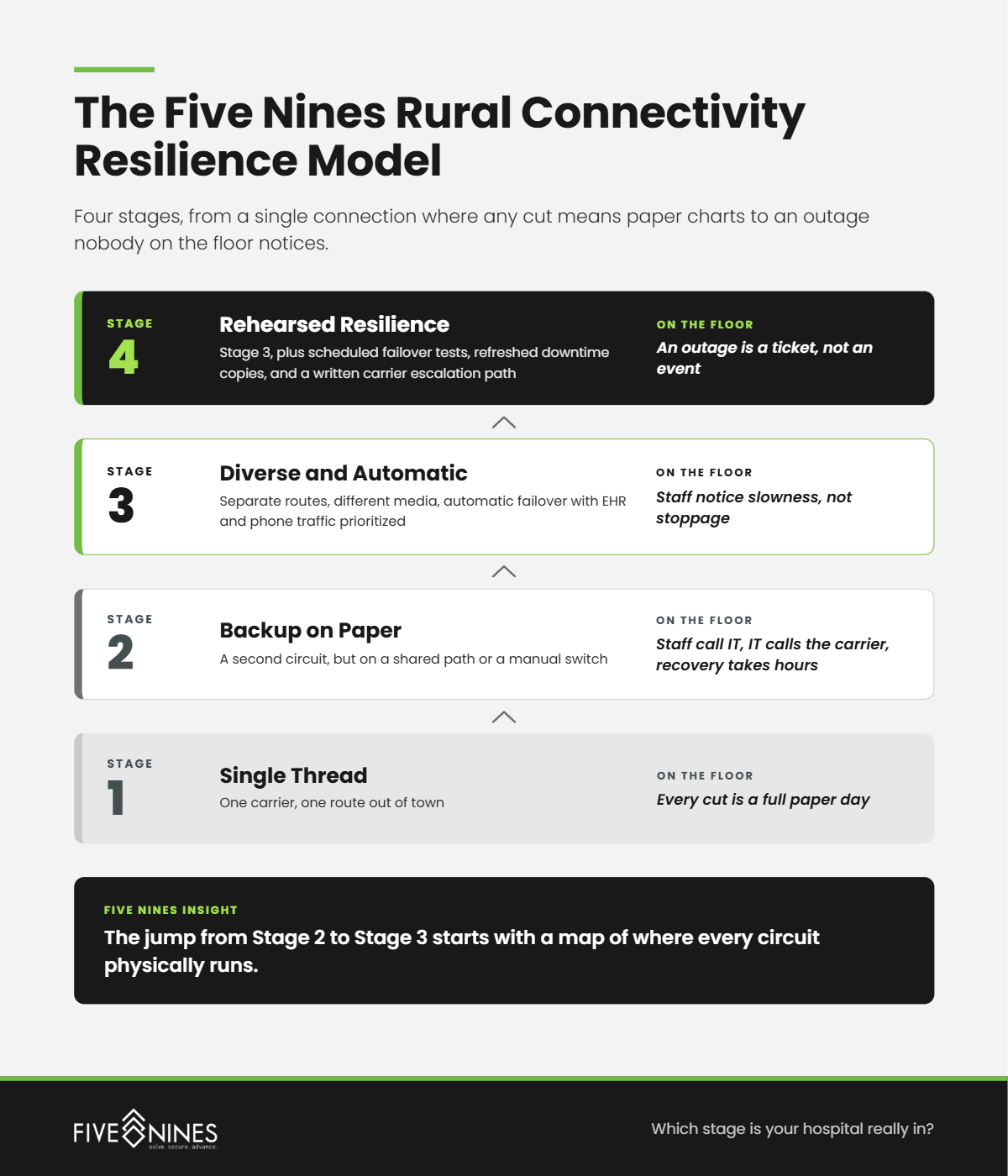
Many rural hospitals Five Nines talks with believe they sit at Stage 3 and actually sit at Stage 2. The gap between those two stages is almost never budget. It is a map of where the wires actually run.
Short answer: Hours comfortably, and days only with real strain. Hospitals that lost connectivity after the 2020 Nashville AT&T explosion spent up to about 36 hours on downtime procedures. The harder cost arrives afterward, when every paper order, result, and medication entry has to be reconciled back into the EHR.
When the December 2020 explosion in Nashville damaged an AT&T facility, Sumner Regional Medical Center moved immediately to paper records, and Thomas Health ran downtime procedures for roughly 36 hours after its link to its data center failed, Becker's Hospital Review reported. Neither hospital caused the outage. Both owned the consequences.
Paper works, for a while. It slows every order, removes medication alerts, and creates a second record that has to be merged by hand. Olympic Medical Center's IT team decided to build an entirely new connection through a partner health system once its outage passed the 16-hour mark with no end in sight. That decision point deserves a name and an owner before the outage, not during it.
Five Nines Insight
Downtime procedures are not a plan until someone has run them on a weekday with a full ER.
Short answer: Five Nines engineers look for the shared physical paths, untested failovers, and hidden dependencies that turn a single fiber cut into a hospital-wide outage. These are the patterns that do not show up on a monitoring dashboard until the day the line goes dark.
Short answer: Often, yes. The FCC's Healthcare Connect Fund, part of its Rural Health Care Program, offers eligible rural health care providers a 65% discount on eligible broadband connectivity costs. Nonprofit hospitals and rural health clinics can apply individually or through a consortium.
The program is administered by USAC, and applications start with an eligibility form before a funding request, according to a US Ignite program summary. For a critical access hospital weighing a second, physically diverse circuit, that discount can change the math on Stage 3.
The funding covers connectivity. It does not design the diversity, configure the failover, or test it. That part still has to be built.
Short answer: Ask questions that force a physical answer, not a reassuring one. A provider who manages rural healthcare connectivity well should be able to show you the route map, the failover behavior, and the date of the last real test without having to look anything up.
If you read the Cortez or Port Angeles story and weren't sure how your hospital would fare, that uncertainty is the finding.
A Five Nines rural healthcare connectivity assessment identifies:
You leave with a connectivity dependency map, your stage on the Five Nines Rural Connectivity Resilience Model, and a prioritized list of fixes.
Uptime isn't a number on a dashboard. It's a nurse who can still open the chart.
.png)
Managed IT services for healthcare work best when one accountable team owns everything between a clinician and the chart: the workstation, the login,...
Your EHR going down during patient hours is not just an IT inconvenience. It delays diagnoses, pushes appointments into overtime, and erodes the...
Why a Vendor Breach Is the Hospital's Financial Problem A third-party breach involving the hospital's ePHI is the hospital's problem regardless of...