A rural hospital cybersecurity plan should include seven things: a named owner and current risk analysis, multifactor authentication and account controls, email protection with staff training, patching and network segmentation, 24/7 threat detection, vendor risk controls, and a tested downtime and recovery plan. Each one exists for the same reason. It keeps patients from being sent somewhere else.
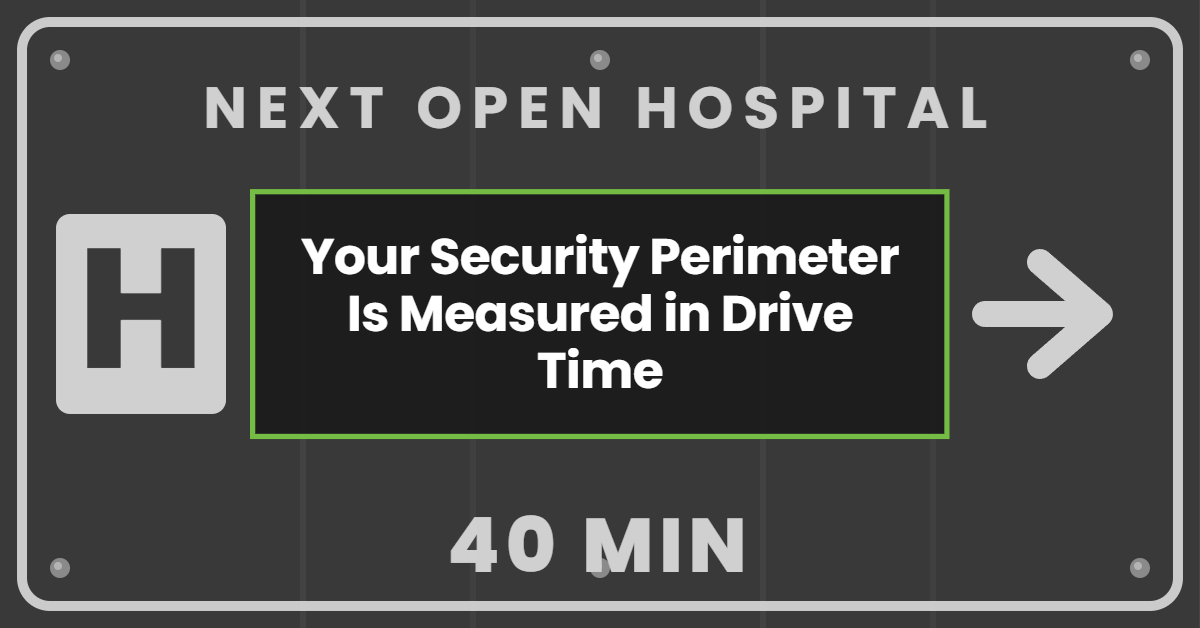
Picture a 25 bed critical access hospital at 2:40 on a Sunday morning. The ER has two patients. The lab analyzer stops talking to the EHR. Then the workstations at the nurses' station lock up with a ransom note. The one IT person is asleep 20 miles away, and the closest hospital with an open bed is a 40 minute drive.
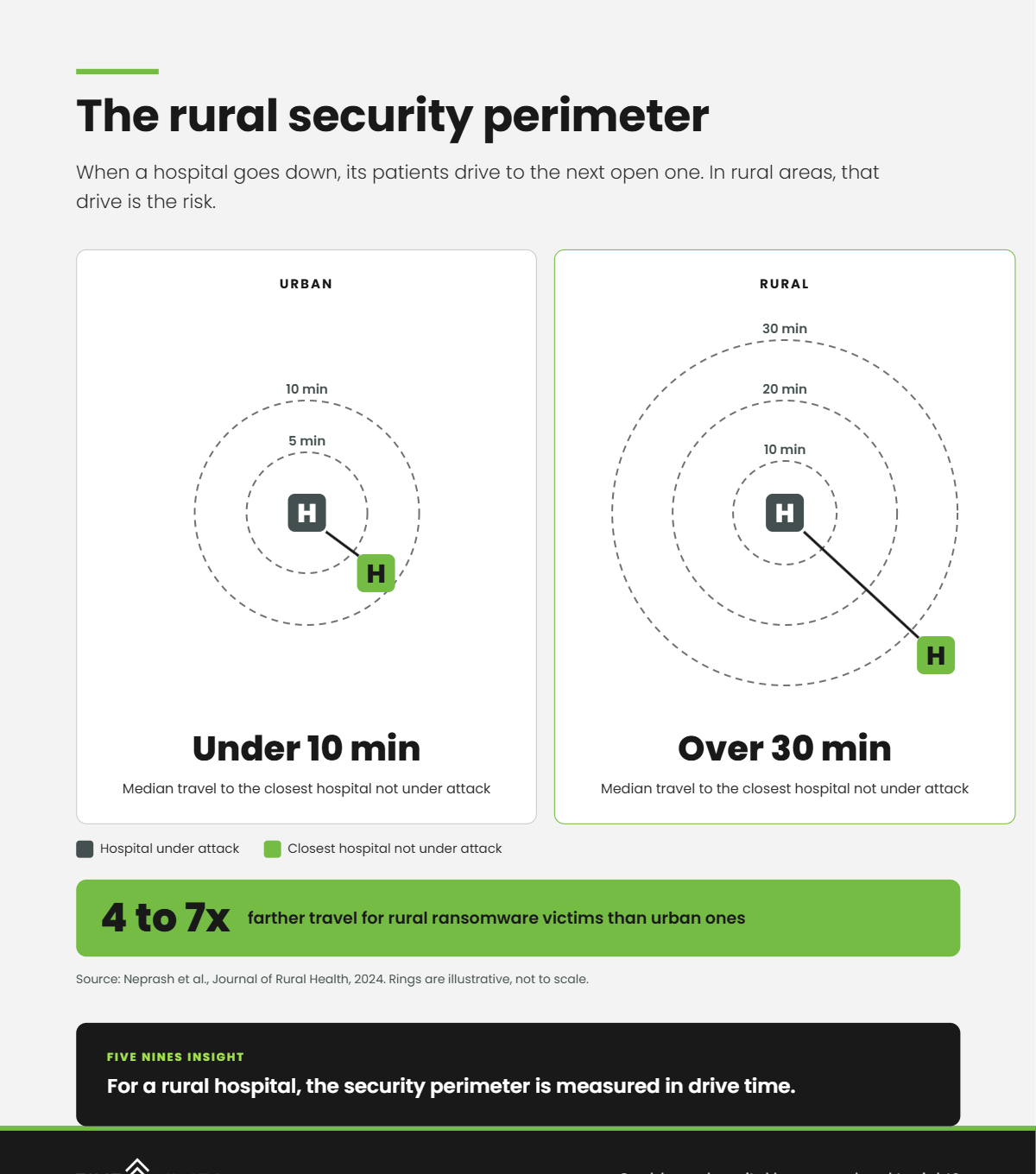
For a rural hospital, the security perimeter is measured in drive time.
That isn't a figure of speech. Research from the University of Minnesota School of Public Health, published in the Journal of Rural Health, found that travel time and distance to the closest hospital not under attack was four to seven times greater for rural ransomware victims than for urban ones. Median travel for rural patients ran past 30 minutes. For urban patients, it was under 10.
So the plan isn't about firewalls. It's about keeping care local. Five Nines Technology Group builds rural hospital security plans around that single test, and the seven components below are how it gets met.
What Are the Seven Parts of a Rural Hospital Cybersecurity Plan?
Short answer: A rural hospital cybersecurity plan has seven parts: governance and risk analysis, identity and access control, email security and training, vulnerability and device management, 24/7 detection and response, vendor risk management, and tested recovery. Five Nines Technology Group maps each part to the HHS Cybersecurity Performance Goals so leaders can see what is covered and what is missing.
|
Plan component |
What it covers |
What it looks like on the floor |
HHS CPG alignment |
|---|---|---|---|
|
1. Governance and risk analysis |
Named owner, annual HIPAA security risk analysis, board reporting |
Someone can answer "who owns cyber here?" without a pause |
Supports all goals |
|
2. Identity and access |
MFA, unique logins, separate admin accounts, same day offboarding |
No shared "nurse1" login at the station; agency and locum staff lose access the day they leave |
MFA, Unique Credentials, Separate Privileged Accounts, Revoke Credentials (Essential) |
|
3. Email and training |
Phishing filters, email authentication, recurring training |
Staff report a suspicious email instead of clicking it |
Email Security, Basic Training (Essential) |
|
4. Vulnerabilities and devices |
Patching, asset inventory, network segmentation, medical device placement |
The infusion pumps and the billing PCs are not on the same flat network |
Mitigate Known Vulnerabilities (Essential); Asset Inventory, Segmentation, Configuration Management (Enhanced) |
|
5. Detection and response |
Endpoint detection and response, centralized logs, 24/7 monitoring |
A human investigates the 2 a.m. alert at 2 a.m. |
Detect and Respond, Centralized Log Collection (Enhanced) |
|
6. Vendor risk |
Contract security terms, vendor remote access control, vendor incident reporting |
The EHR vendor's remote tool is off until someone turns it on |
Vendor Cybersecurity Requirements (Essential); Third Party Incident Reporting (Enhanced) |
|
7. Recovery and continuity |
Offline or immutable backups, downtime kits, incident response plan, transfer agreements |
Paper downtime forms are current, and restores have been tested this year |
Incident Planning and Preparedness (Essential and Enhanced) |
Goal names come from the HHS Healthcare and Public Health Cybersecurity Performance Goals.
Why Is Cybersecurity Different for a Rural or Critical Access Hospital?
Short answer: Rural hospitals face the same attacks as urban systems but absorb them with fewer people, thinner margins, and no nearby backup facility. University of Minnesota researchers found rural ransomware victims were smaller and less likely to belong to a large health system, and their patients traveled four to seven times farther for care.
The attacks aren't different. The consequences are.
An urban hospital that goes on diversion sends ambulances across town. A rural hospital sends them across the county. The same Minnesota research team found that ransomware cut hospital volume and revenue sharply in the first week of an attack for rural and urban hospitals alike. The difference is who can absorb it. According to the University of Minnesota School of Public Health, rural hospitals serve patients who are often older, sicker, and already facing barriers to care.
The stakes are clinical too. A separate study by the same team, published in the American Economic Journal: Economic Policy, found in-hospital mortality rose by roughly a third for Medicare patients already admitted when a ransomware attack began.
The staffing math matters too. Rural hospitals often run IT with one to three people who also handle phones, printers, and the EHR upgrade. That team cannot also watch the network all night.
Five Nines Insight
A rural hospital's cyber plan is a patient continuity plan. If a control doesn't help keep care local, it's in the wrong order on the list.
Which Cybersecurity Controls Should a Rural Hospital Put in Place First?
Short answer: Start with the ten essential HHS Cybersecurity Performance Goals: patch internet facing systems, secure email, require multifactor authentication, train staff, encrypt data, revoke departing users, plan for incidents, use unique credentials, separate admin accounts, and set vendor security requirements. They are free to adopt and built from attack patterns seen at U.S. hospitals.
HHS published these goals in January 2024 as a voluntary floor. They were built from common attack vectors identified in its Hospital Cyber Resiliency Landscape Analysis, and they map directly to the Health Industry Cybersecurity Practices (HICP) guidance from the 405(d) program.
For a rural hospital, the order matters more than the list. Three essentials carry most of the weight:
- Multifactor authentication on anything reachable from the internet. Email, VPN, remote EHR access, and vendor portals first.
- Patching what faces the internet. Firewalls, remote access appliances, and web portals are where known exploits land.
- Unique and separate accounts. Shared clinical logins and everyday admin rights are how one stolen password becomes a hospital wide outage.
The Hidden Risk
Rural hospitals run on traveling staff: locum physicians, agency nurses, visiting specialists. Every account that outlives its owner's contract is an open door with a valid key.
How Can a Small Hospital IT Team Cover Threats Around the Clock?
Short answer: A small hospital IT team covers threats around the clock by pairing endpoint detection and response with a staffed security operations center. Five Nines Technology Group runs an in house SOC whose analysts monitor client environments 24/7, so an alert at 2 a.m. reaches a person who can isolate a device before ransomware spreads.
Attackers don't keep business hours. Nights, weekends, and holidays are when a small hospital has the fewest eyes on its systems.
Tools alone don't solve this. An alert that lands in an inbox at 2 a.m. and gets read at 8 a.m. is six hours of free access. What a rural hospital needs is a human who sees the alert, confirms it, and contains it while the local IT lead sleeps. That is the gap a managed SOC fills.
What Belongs in a Rural Hospital's Downtime and Recovery Plan?
Short answer: A rural hospital downtime and recovery plan needs offline or immutable backups with tested restores, current paper downtime kits for every unit, a written incident response plan with named roles, and prearranged agreements with regional hospitals and EMS for diversion and transfers. Each piece should be rehearsed at least once a year.
This is the part most plans skip, and it's the part that decides how long patients wait.
A useful recovery plan answers concrete questions. How many hours can the ER run on paper? Who calls the regional referral center, and what do they say? Which systems come back first: the EHR, lab, pharmacy, or imaging? How long does a full restore take, measured, not guessed?
The Minnesota researchers made the regional point directly: rural hospitals should coordinate with nearby facilities and plan ahead. A tabletop exercise that includes your EMS agency and your nearest referral hospital tests the plan where it will actually break.
What Leadership Misses
Backups prove you saved the data. Only a timed restore proves you can get it back before the next shift.
How Should Rural Hospitals Manage EHR Vendor and Third Party Risk?
Short answer: Rural hospitals should require security terms in every vendor contract, control when vendors can connect remotely, and plan for a vendor outage as seriously as a local one. HHS lists vendor cybersecurity requirements as an essential goal and third party incident reporting as an enhanced goal.
Small hospitals depend on a short list of vendors for almost everything: the EHR, lab interfaces, billing, imaging, and the clearinghouse. That concentration is efficient until one of those vendors is the one that gets hit.
Three controls make the biggest difference. Vendor remote access stays off by default and gets switched on for a specific job. Contracts require prompt notice of a vendor breach. And the downtime plan includes the scenario where your systems are fine but a critical vendor is down.
Is the HIPAA Security Rule Changing for Rural Hospitals?
Short answer: As of October 2026, the proposed HIPAA Security Rule overhaul published in January 2025 is still not final. Federal regulatory tracking now points to July 2027 for final action. The current Security Rule remains in force, and the proposal's core controls, including MFA, encryption, and asset inventories, already reflect reasonable security today.
The proposal would turn several "addressable" safeguards into required ones. Health care law firm Feldesman reports that the anticipated final action date moved to July 2027, and that organizations remain subject to the current rule in the meantime.
For a rural hospital, the delay is breathing room, not a reason to wait. Every control in the seven part plan above lines up with where the rule is heading.
How Can a Rural Hospital Tell How Ready Its Cybersecurity Plan Is?
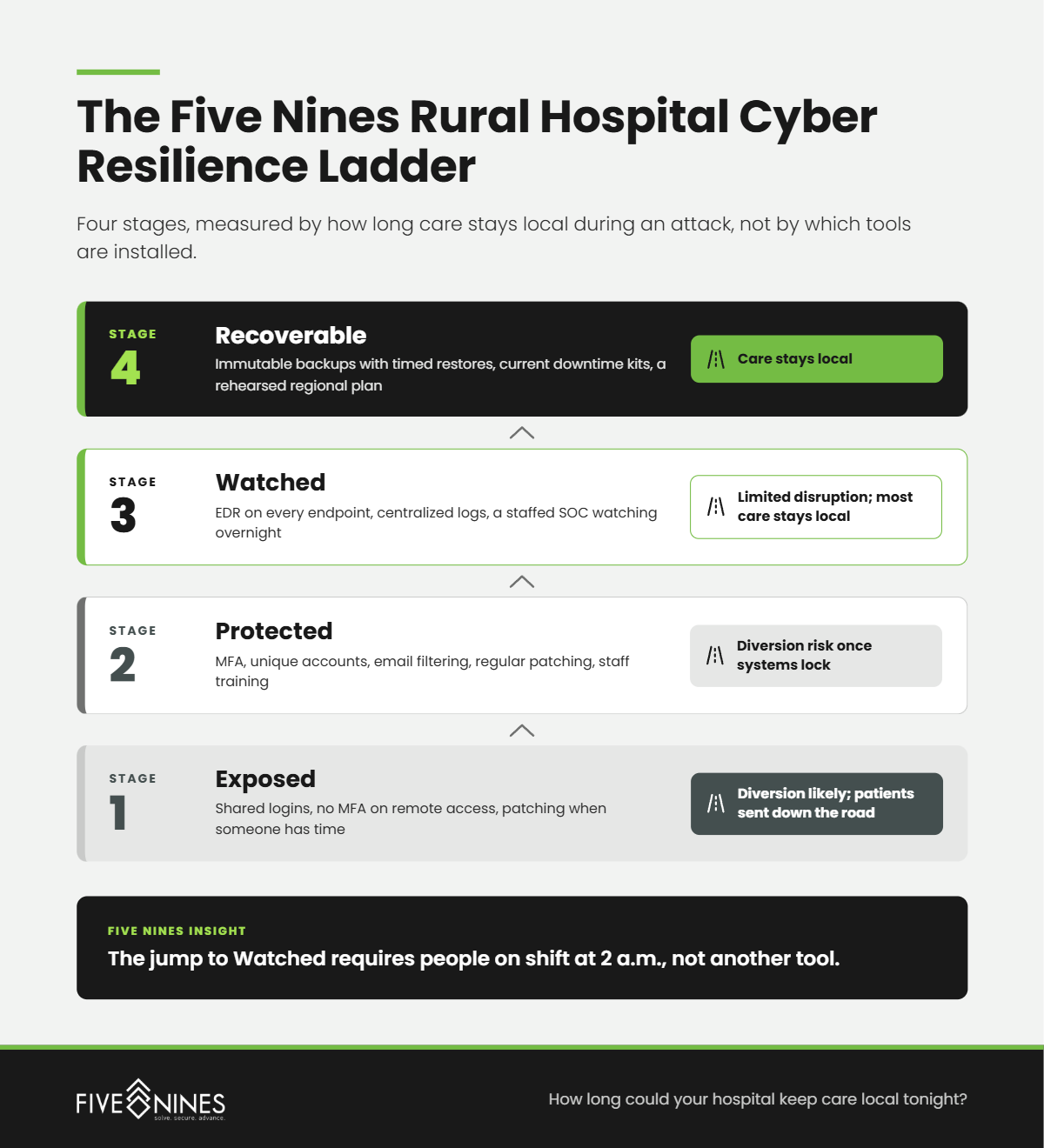
Short answer: Rural hospitals can measure readiness with the Five Nines Rural Hospital Cyber Resilience Ladder, a four stage model that moves from Exposed to Protected, Watched, and Recoverable. Each stage is defined by what staff see on the floor and how long care would stay local during an attack, not by which tools are installed.
The Five Nines Rural Hospital Cyber Resilience Ladder
|
Stage |
What it looks like on the floor |
What a ransomware night looks like |
What moves you up |
|---|---|---|---|
|
1. Exposed |
Shared logins, no MFA on remote access, patching when someone has time |
Discovered at shift change; diversion likely; recovery measured in weeks |
Adopt the ten HHS essential goals |
|
2. Protected |
MFA, unique accounts, email filtering, regular patching, staff training |
Fewer ways in, but nobody sees an intrusion until systems lock |
Add 24/7 detection and response |
|
3. Watched |
EDR on every endpoint, centralized logs, a staffed SOC watching overnight |
A device is isolated before spread; care continues with limited disruption |
Test restores, downtime kits, and transfer agreements |
|
4. Recoverable |
Immutable backups with timed restores, current downtime kits, rehearsed regional plan |
Even a successful attack is a bad shift, not a lost month |
Retest annually and after every major change |
What Does Five Nines Look for in a Rural Hospital Security Assessment?
Short answer: Five Nines Technology Group looks for the gaps that turn one compromised account into a hospital wide outage: shared logins, vendor access that never shuts off, flat networks, untested backups, and stale downtime procedures. These are rarely visible on a compliance checklist, but they decide how long care stays local during an attack.
- The shared station login. A generic account at the nurses' station saves seconds during a shift and erases the audit trail during an incident.
- The contract that ended but the account didn't. Locum, agency, and visiting specialist accounts that stay active long after the last shift.
- Vendor remote access that never turns off. Support tools left running around the clock so the vendor can connect without calling first.
- The flat network. Medical devices, guest Wi-Fi, and business PCs sharing one network, so malware on a front desk computer can reach clinical systems.
- Backups nobody has restored. Jobs that report success every night, with no record of a timed restore of the EHR.
- The downtime binder from three EHR versions ago. Paper procedures that reference forms, phone numbers, and workflows that no longer exist.
What Should a Rural Hospital Ask a Cybersecurity Provider?
Short answer: Rural hospital leaders should ask any cybersecurity provider who watches alerts overnight, how fast a compromised device gets isolated, whether the provider has tested a full restore, how it handles vendor remote access, and whether it will sign a Business Associate Agreement. Vague answers to any of these are a warning sign.
- Who is watching our environment at 2 a.m. on a Sunday, and are they your employees or a third party?
- When you see a confirmed threat, how quickly can you isolate the device, and do you need our permission first?
- When did you last perform a full timed restore for a client like us, and how long did it take?
- How will you control EHR and device vendor remote access?
- How do your services map to the HHS Cybersecurity Performance Goals and our HIPAA risk analysis?
- Will you sign a Business Associate Agreement, and what does it cover?
- Who sits in the room with us if an auditor or OCR comes calling?
How Long Could Your Hospital Keep Care Local Without Its Network?
If you can't answer that in hours, your plan has a gap, and it's better to find it on a Tuesday afternoon than a Sunday at 2 a.m.
A Five Nines rural hospital security assessment identifies:
- Where your plan sits on the Rural Hospital Cyber Resilience Ladder
- Which of the ten HHS essential goals are met, partly met, or missing
- Accounts, vendor connections, and network paths that could turn one click into an outage
- How long a real restore of your EHR and core systems would take
- The gaps between your downtime binder and how your units work today
You leave with a prioritized roadmap tied to your HIPAA risk analysis, ranked by what keeps care local first.
The question was never whether your hospital has a plan. It's whether the plan keeps your patients close to home.