The best Midwest IT support for a rural hospital is the provider that covers all five lanes of risk: staff devices, clinical systems, 24/7 security monitoring, HIPAA evidence, and the governance that ties every vendor together. For most critical access hospitals comparing managed IT services for healthcare, that means a regional healthcare MSP, or a deliberate mix of providers with one clearly accountable owner.
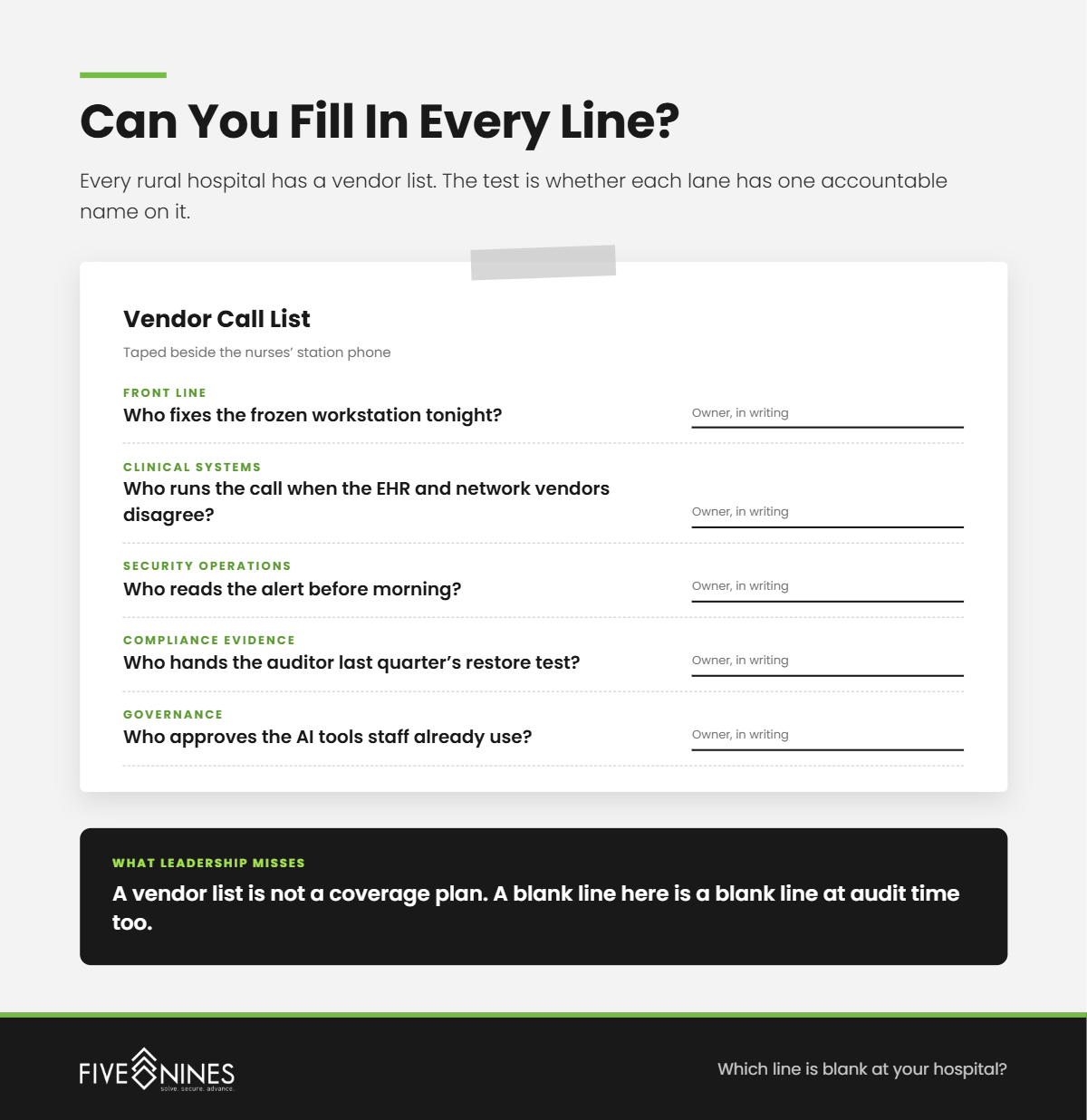
Here is what the gap looks like at 2 a.m. The EHR vendor’s ticket line is open. The security company’s alert landed in an inbox nobody reads overnight. The local IT shop is two hours away on a county road that hasn’t been plowed. The night supervisor is standing at the nurses’ station with a frozen workstation and a list of phone numbers taped beside the wall phone.
Everyone on that list is a vendor. Nobody on it is accountable.
That gap is common. In a 2025 readiness survey of 187 small and rural hospital leaders, Black Book Research found 59% lack 24/7 threat monitoring or a dedicated security operations center, and 44% outsource all cybersecurity without adequate governance oversight.
Five Nines Technology Group is a Lincoln, Nebraska managed IT provider, and we are on this list. So instead of asking you to trust our ranking, we built the comparison around a scoring model you can hold us to as well.
What Should a Rural Hospital Look for in Managed IT Services for Healthcare?
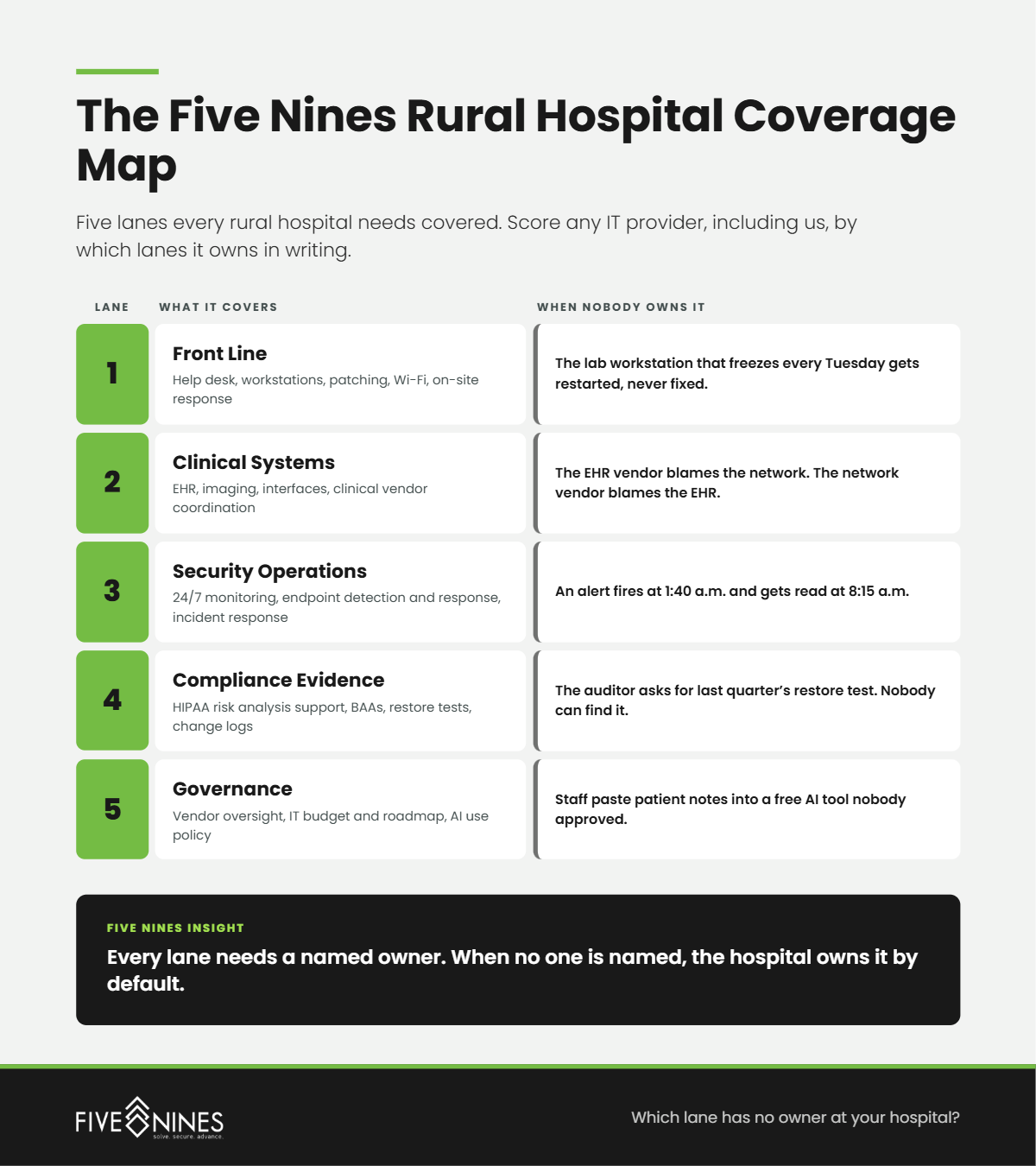
Short answer: Look for coverage, not features. Managed IT services for healthcare should cover five lanes at a rural hospital: the front line, clinical systems, security operations, compliance evidence, and governance. Five Nines Technology Group calls this the Rural Hospital Coverage Map, and any provider can be scored against it.
Most provider comparisons line up feature lists. Help desk, check. EDR, check. HIPAA, check. The checkmarks look the same on every website, which is why they rarely predict who answers at 2 a.m.
The better test is to ask which lane each provider owns, and which lanes fall to nobody.
The Five Nines Rural Hospital Coverage Map
|
Lane |
What it covers |
What it looks like on the floor when nobody owns it |
|---|---|---|
|
1. Front Line |
Help desk, workstations, patching, Wi-Fi, on-site response |
The lab workstation that freezes every Tuesday gets restarted, never fixed. |
|
2. Clinical Systems |
EHR, imaging, interfaces, coordination with clinical vendors |
The EHR vendor blames the network. The network vendor blames the EHR. The chart still won’t open. |
|
3. Security Operations |
24/7 monitoring, endpoint detection and response, incident response |
An alert fires at 1:40 a.m. and gets read at 8:15 a.m. |
|
4. Compliance Evidence |
HIPAA risk analysis support, BAAs, backup restore tests, change logs |
The auditor asks for last quarter’s restore test and nobody can find it. |
|
5. Governance |
Vendor oversight, IT budget and roadmap, AI use policy |
Staff paste patient notes into a free AI tool that nobody approved. |
Which Types of IT Providers Serve Rural Midwest Hospitals?
Short answer: Rural hospitals in the Midwest typically choose from six provider types: regional healthcare MSPs, EHR vendor managed services, national healthcare MSPs, healthcare IT firms with an EHR focus, healthcare security specialists, and local generalist IT shops. Each covers different lanes, so the right fit depends on which lanes you already own.
The examples below come from each provider’s own published service descriptions. Scope changes, so verify every lane in your own discovery calls.
1. Regional healthcare MSP
Example: Five Nines Technology Group (Lincoln, Nebraska, with offices in Omaha, Kearney, Central City, and St. Louis). Five Nines has served more than 100 healthcare organizations, signs business associate agreements, and runs a 24/7 service desk with MFA, EDR, immutable backups, phishing training, and DNS filtering included. One team coordinates EHR, imaging, and telecom vendors. An 18-bed critical access hospital partner, with 90+ users, grew capacity 20% over three years on a budgeted modernization plan.
Best for: hospitals that want one accountable owner across all five lanes. Ask: the on-site response commitment for your specific town.
2. EHR vendor managed services
Examples: TruBridge and MEDHOST. TruBridge focuses on rural and community hospitals with EHR, revenue cycle, and healthcare IT services, and its Application Managed Services tier includes system monitoring, incident support, and change control. MEDHOST offers hosted and managed IT services for community hospitals.
Best for: deep knowledge of the clinical application. Ask: who owns the network, phones, imaging workstations, and 24/7 security monitoring around the EHR.
3. National healthcare MSPs
Examples: Dataprise and Medicus IT. Dataprise, based in Rockville, Maryland, offers 24/7 managed IT for hospitals and practices and placed #7 in the healthcare category of ChannelE2E’s 2024 Top Vertical Market MSPs list. Medicus IT, a healthcare-focused MSP in Alpharetta, Georgia, acquired Nexus Practice IT Services, which served healthcare organizations in Ohio and the Midwest.
Best for: organizations that value national scale and standardized process. Ask: who drives to your building in rural Kansas or Nebraska, and how long it takes.
4. Healthcare IT firms with an EHR focus
Example: MTS (MedTech Solutions). Its Midwest healthcare page lists community health centers, ambulatory surgery centers, provider groups, tribal health, and specialty clinics, with services spanning EHR managed services, revenue cycle, IT system management, cybersecurity, and cloud hosting.
Best for: clinic-heavy networks with EHR and billing needs. Ask: for critical access hospital references, since the published client list centers on clinic settings.
5. Healthcare security specialists
Example: Fortified Health Security, which Black Book’s 2025 survey identified for healthcare cybersecurity consulting and managed security services. Rural hospitals should also know Microsoft’s Cybersecurity Program for Rural Hospitals, which offers free assessments and discounted tools. It is a resource, not a provider.
Best for: deep security and assessment work. Ask: who handles the front line and clinical systems, because security specialists usually stop at lanes 3 and 4.
6. Local generalist IT shops
Best for: fast, familiar on-site help in your own county. Ask: for HIPAA evidence samples, 24/7 security monitoring details, and EHR vendor coordination experience. Healthcare depth varies widely at this tier.
How Do These Provider Types Compare Across the Five Lanes?
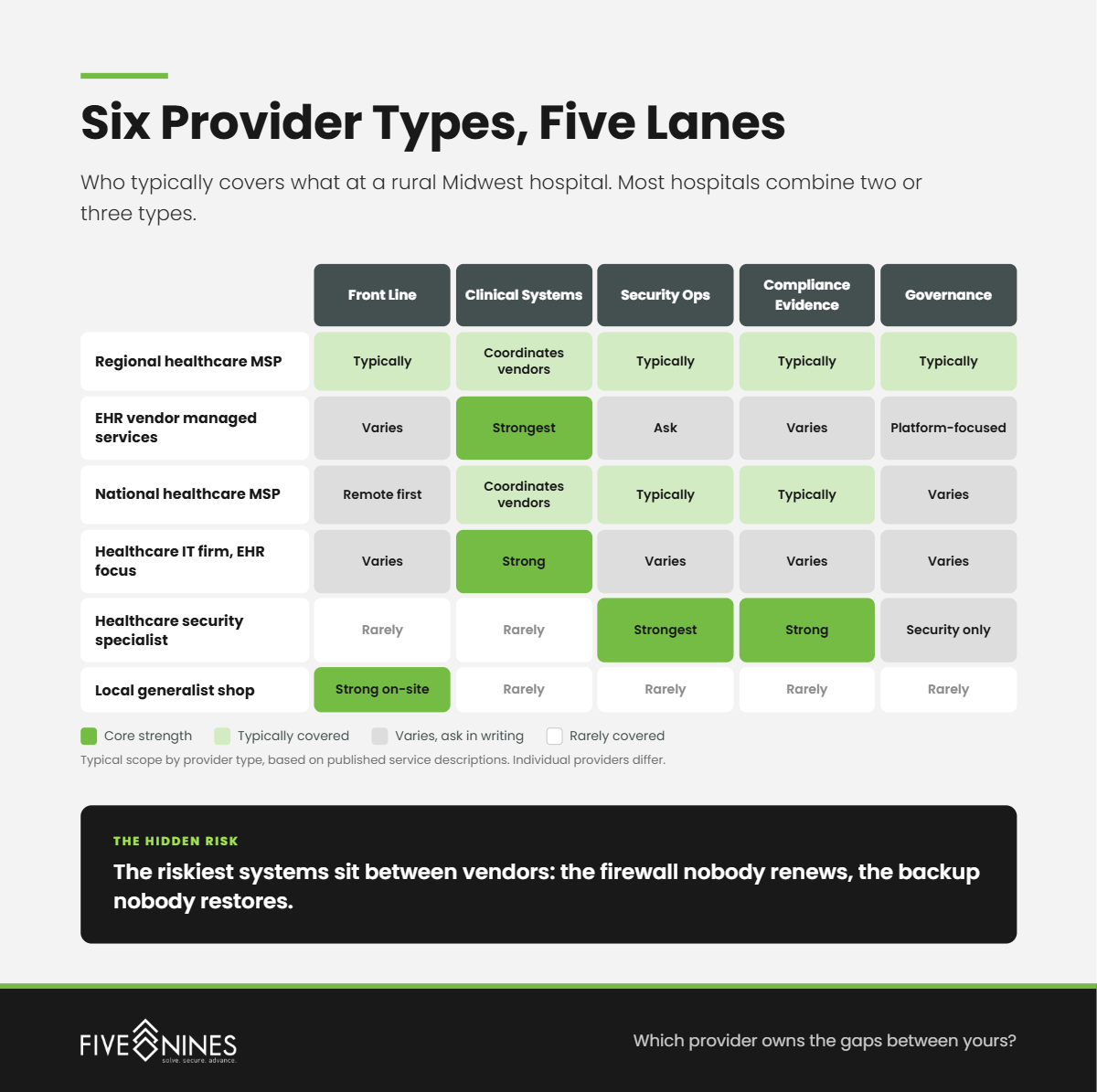
Short answer: Only regional healthcare MSPs typically cover all five lanes under one contract. EHR vendors lead on clinical systems, security specialists lead on security operations, and local shops lead on drive time. Most rural hospitals end up combining two or three, which makes governance the lane that decides whether the combination works.
|
Provider type |
Front Line |
Clinical Systems |
Security Ops |
Compliance Evidence |
Governance |
|---|---|---|---|---|---|
|
Regional healthcare MSP |
Typically |
Coordinates vendors |
Typically |
Typically |
Typically |
|
EHR vendor managed services |
Varies |
Strongest |
Ask |
Varies |
Platform-focused |
|
National healthcare MSP |
Remote first |
Coordinates vendors |
Typically |
Typically |
Varies |
|
Healthcare IT firm, EHR focus |
Varies |
Strong |
Varies |
Varies |
Varies |
|
Healthcare security specialist |
Rarely |
Rarely |
Strongest |
Strong |
Security only |
|
Local generalist shop |
Strong on-site |
Rarely |
Rarely |
Rarely |
Rarely |
Typical scope by provider type, based on published service descriptions. Individual providers differ. Verify each cell in discovery.
The Hidden Risk
When three vendors each own part of a rural hospital’s IT, the riskiest systems sit in between: the firewall nobody renews, the backup nobody restores, the account nobody disables.
Should a Rural Hospital Let Its EHR Vendor Run Its IT?
Short answer: An EHR vendor can be an excellent application partner, but its managed services usually center on its own platform. Before signing, rural hospitals should get written scope for the network, Wi-Fi, phones, imaging workstations, and 24/7 security monitoring that surround the EHR.
Critical access hospital CFOs weigh this option often, and it makes sense. One contract, one bill, and a vendor that already knows the clinical workflow.
The risk lives at the edges. The EHR runs on switches, wireless access points, workstations, and identity systems that someone has to patch, monitor, and replace on schedule. If the contract does not name an owner for each one, the hospital is the owner by default.
What Leadership Misses
A vendor list is not a coverage plan. If leadership cannot name who owns each lane at 2 a.m., the hospital owns it by default.
How Much Does Distance Matter for Rural Hospital IT Services?
Short answer: Distance matters most when the failure is physical. Remote tools close most tickets, but a failed switch, a power event, or a ransomware rebuild needs people in the building. Microsoft’s 2025 rural hospital report found ransomware leaves hospitals down an average of 18.7 days at an estimated $1.9 million per day.
When Sky Lakes Medical Center, a 90-bed rural hospital in Oregon, was hit in 2020, its network was down for 28 days and 2,500 computers had to be repaired or replaced. That recovery happened one machine at a time, by hand.
For a Midwest critical access hospital, the question is concrete. How many hours separate your building from the nearest engineer who knows your environment? Put the answer in the contract.
What Does Five Nines Usually Find in a Rural Hospital IT Assessment?
Short answer: Five Nines engineers most often find gaps between vendors rather than failures inside them: equipment nobody owns, backups nobody has restored, and agreements nobody has reviewed. These patterns show up in hospitals that already pay for outsourced IT.
- The orphaned firewall. A previous vendor installed it. Nobody on staff holds the admin credentials or knows when the license lapses.
- The backup that has never been restored. Jobs report success every night, but nobody has rebuilt a full server from them since installation.
- The shared night-shift login. A generic account at the nurses’ station keeps care moving and quietly skips MFA.
- The BAA drawer. Business associate agreements signed years ago with vendors whose services, or owners, have since changed.
- Unapproved AI at the keyboard. Staff use consumer AI tools to summarize notes or draft letters with no policy and no approved tool list.
What Questions Should You Ask a Healthcare IT Support Provider?
Short answer: Ask questions that expose ownership, not features. The seven below map to the five lanes of the Coverage Map, and any provider serving rural hospitals should answer each one in writing before you sign.
- Which of the five lanes do you own in writing, and which do you hand back to us?
- Who answers at 2 a.m., and can that person act, or only open a ticket?
- How many hours separate your nearest engineer from our building in January?
- Will you sign a BAA, and will you help us collect BAAs from our other vendors?
- Can we see a sample of the HIPAA evidence you would hand an auditor, such as a restore test or change log?
- When a problem crosses our EHR, imaging, and telecom vendors, who runs the call?
- How will you help us govern staff use of AI tools?
Which of Your Five Lanes Has No Owner Right Now?
If your hospital’s IT runs on a taped list of vendor phone numbers, the gap is already there. You just haven’t needed it yet.
A Five Nines Rural Hospital Coverage Assessment identifies:
- Which lanes each current vendor owns in writing, and which fall to nobody
- Security monitoring gaps between business hours and 2 a.m.
- HIPAA evidence an auditor would ask for that you cannot produce today
- Equipment, accounts, and licenses with no clear owner
- On-site response time from your provider to your building
You leave with a lane-by-lane coverage map of your hospital, owners named and gaps ranked by risk.
The best IT partner for a rural hospital is the one that leaves no lane to chance.