When a rural hospital's only IT person leaves, the hospital loses more than an employee. It loses the admin passwords, the network map, the renewal dates, the vendor relationships, and often its designated HIPAA Security Official, all on the same day, unless someone captures them first.
Picture the CEO of a small critical access hospital reading a two-paragraph resignation letter. The person who wrote it knows why the admissions printer only works from one workstation, which certificate on the lab interface expires in March, and which vendor actually picks up after 5 p.m. None of it is written down. All of it worked yesterday.
The network documentation lives in one person's head, and that person just gave two weeks' notice.
This is a common story, not a rare one. When the U.S. Department of Health and Human Services' Health Care Industry Cybersecurity Task Force reported to Congress in 2017, it found that three out of four hospitals had no designated security person. Task force member Josh Corman told Healthcare IT News that hospitals in smaller, less desirable locations struggle most to keep one on staff.
What Actually Leaves When the Only IT Person Leaves?
Short answer: Five things leave with them: the keys (admin credentials and MFA), the map (how the network and clinical systems connect), the calendar (backups, patches, certificate and domain renewals), the contacts (vendors and support lines), and the duty (the HIPAA Security Official role). Five Nines Technology Group calls this the Departure Inventory.
Most leaders picture the passwords first. The passwords are the easy part. The calendar is the one that bites later.
Nothing breaks on the last day. Things break in month three, when a certificate quietly expires and the interface between the lab system and the EHR stops passing results, and nobody left in the building knows that certificate existed.
The contacts are the quiet loss. Rural IT runs on relationships: the carrier rep who escalates a circuit outage, the EHR support engineer who knows your build. Those relationships are tied to a first name, and the first name just resigned.
Five Nines Insight
A rural hospital with one IT person does not have an IT department. It has an IT memory, and a memory does not transfer with a resignation letter unless someone writes it down.
Why Is the Resignation a Compliance Event?
Short answer: The HIPAA Security Rule requires every covered entity to name a security official responsible for its security policies and procedures. In small rural hospitals that title often sits with the IT person. When they resign, the role has an end date, and the access they held must be shut off on schedule.
The requirement is the "assigned security responsibility" standard in the HIPAA Security Rule, 45 CFR 164.308(a)(2). The same section covers workforce termination procedures, which means ending a departing employee's access to electronic protected health information.
Here is where it gets uncomfortable. The departing IT person usually holds the most privileged accounts in the building. Turning off their access is the right move, and it is the one move nobody else knows how to make.
What Leadership Misses
The day the resignation letter arrives, the hospital's Security Official has an end date. The hospital needs a named successor before that date, not after a replacement is hired.
Why Is It So Hard for a Rural Hospital to Replace Its IT Person?
Short answer: Rural hospitals compete for scarce IT and security talent with tighter budgets and smaller local labor markets. The Health Sector Coordinating Council's 2025 report On the Edge, built on interviews with 42 executives in 31 states, found resource-constrained providers short on people, beyond any training gap.
The Health Sector Coordinating Council report covered critical access hospitals, community health centers, and other resource-constrained providers. TechTarget's coverage adds that respondents leaned on help desk staff to fill security gaps and struggled to attract qualified cyber talent to rural organizations.
The stakes are not small. According to the American Hospital Association, rural hospitals provide care to about 60 million Americans.
Most hospitals respond to a resignation by posting the job. That is reasonable, and it misses the point. A new hire who inherits an undocumented network becomes the next single point of failure on their first day.
The Hidden Risk
Hiring one replacement restarts the clock on the same risk. The question is not who replaces the person. It is where the knowledge lives after they go.
Should a Rural Hospital Hire a Replacement or Outsource IT?
Short answer: Either can work, as long as the new model removes the single point of failure. Some rural hospitals move to fully managed IT. Others keep one internal person and add a co-managed partner for 24/7 monitoring, security, and documentation. Five Nines Technology Group supports both models.
|
Model |
What the hospital gets |
Where it breaks |
Fits when |
|---|---|---|---|
|
Hire one replacement |
A familiar face on site who learns your systems |
Same single point of failure; no coverage for vacations, nights, or the next resignation |
You can document everything first and fund backup coverage |
|
Fully managed IT |
A help desk, monitoring, patching, security, and strategy from one team |
Needs a clear on-site support plan for a rural location |
You have no internal IT and want one accountable partner |
|
Co-managed IT |
Your internal person runs daily operations; the partner covers security operations, after-hours monitoring, and documentation |
Roles must be written down or work falls between the two |
You want someone in the building and depth behind them |
The right answer depends on size, budget, and how far the hospital sits from support. For a broader look at which services matter at each stage, see which managed IT services support growing healthcare organizations. The wrong answer is any model where the network still lives in one head.
What Should a Hospital Capture Before the Last Day?
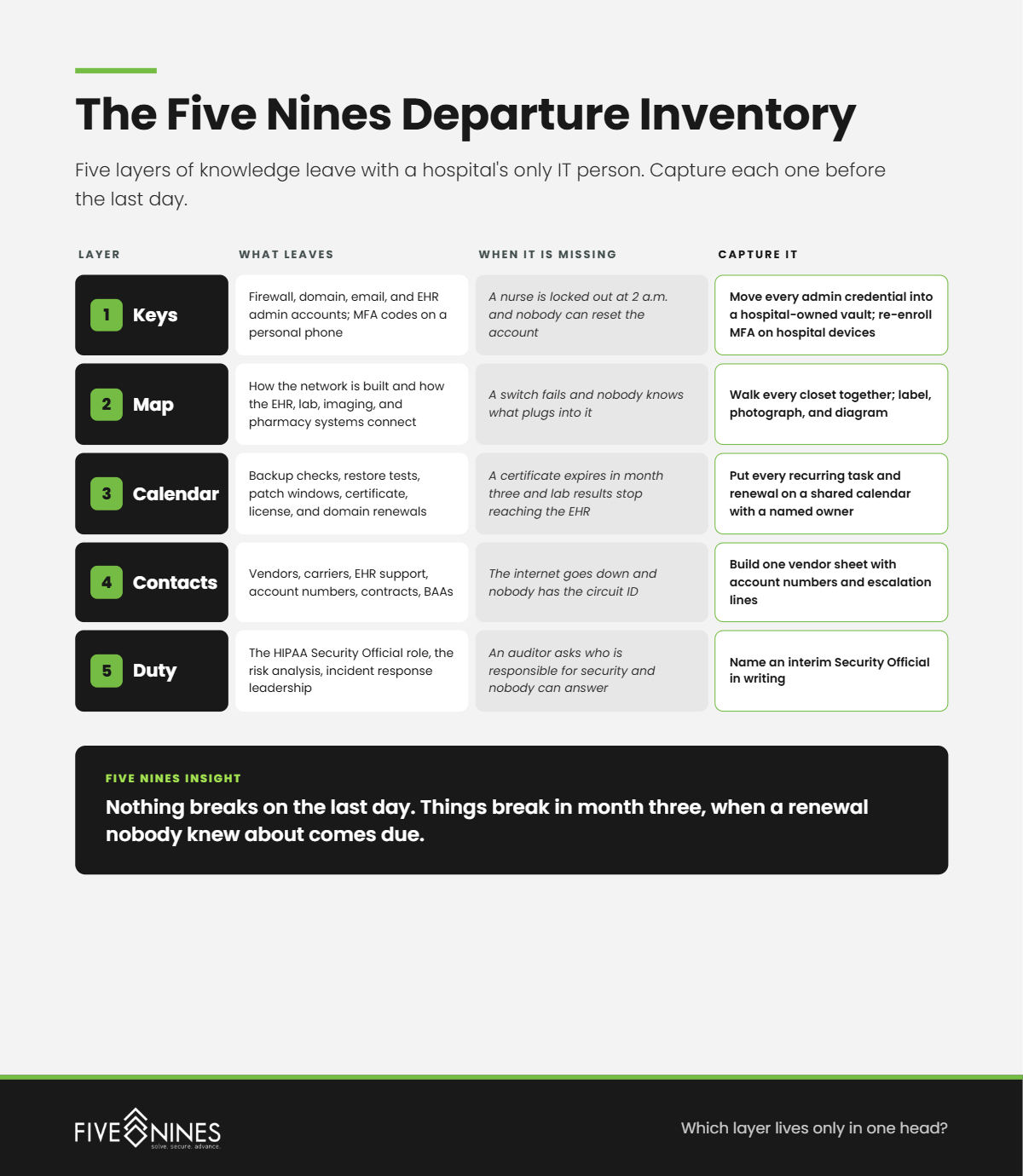
Short answer: Capture five layers before the last day: keys, map, calendar, contacts, and duty. Five Nines Technology Group organizes this as the Five Nines Departure Inventory, a checklist that turns one person's memory into documentation the hospital owns and any successor, internal or outsourced, can use.
The Five Nines Departure Inventory
|
Layer |
What leaves with them |
What it looks like on the floor |
Capture it before the last day |
|---|---|---|---|
|
1. Keys |
Firewall, domain, email, and EHR admin accounts; MFA codes on a personal phone |
A nurse is locked out at 2 a.m. and nobody can reset the account |
Move every admin credential into a hospital-owned password vault; re-enroll MFA on hospital devices; create two named emergency admin accounts |
|
2. Map |
How the network is built and how the EHR, lab, imaging, and pharmacy systems connect |
A switch fails and nobody knows what plugs into it |
Walk every network closet together; label and photograph; produce a diagram and a system inventory |
|
3. Calendar |
Backup checks, restore tests, patch windows, certificate, license, and domain renewals |
A certificate expires in month three and lab results stop reaching the EHR |
Put every recurring task and renewal date on a shared calendar with a named owner |
|
4. Contacts |
Vendors, carriers, EHR support, account numbers, contracts, business associate agreements |
The internet goes down and nobody has the circuit ID or the escalation line |
Build one vendor sheet: company, account number, support line, escalation contact, contract end date |
|
5. Duty |
The HIPAA Security Official role, the risk analysis, incident response leadership |
An auditor or cyber insurer asks who is responsible for security and nobody can answer |
Name an interim Security Official in writing; locate the latest risk analysis and incident response plan |
How Should a Hospital Use the Two-Week Notice Period?
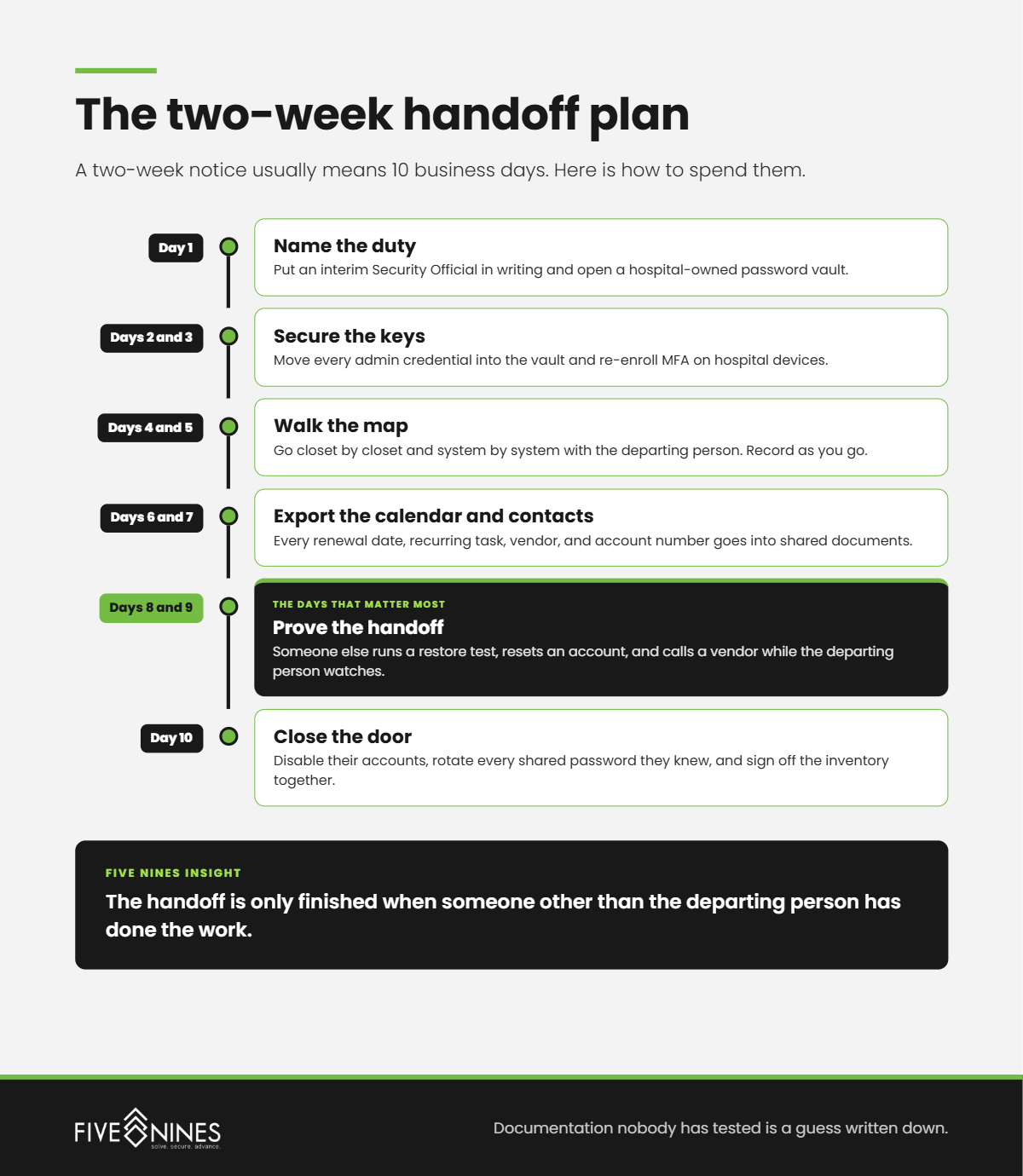
Short answer: Treat the notice period as 10 business days of structured handoff: name the duty first, secure the keys, walk the map, export the calendar and contacts, then prove the handoff by having someone else do the work while the departing person can still correct it.
- Day 1: Name the duty. Put an interim Security Official in writing and open a hospital-owned password vault.
- Days 2 and 3: Secure the keys. Move every admin credential into the vault and re-enroll MFA on hospital devices.
- Days 4 and 5: Walk the map. Go closet by closet and system by system with the departing person. Record as you go.
- Days 6 and 7: Export the calendar and contacts. Every renewal date, recurring task, vendor, and account number goes into shared documents.
- Days 8 and 9: Prove the handoff. Have someone else run a restore test, reset an account, and call a vendor while the departing person watches and corrects.
- Day 10: Close the door. Disable their accounts, rotate every shared password they knew, and sign off the inventory together.
Days 8 and 9 matter most. Documentation nobody has tested is a guess written down. Test it while the one person who can answer questions is still in the building.
The Rule of Two
Every critical system needs two people, or one person and one partner, who can log in, explain it, and fix it. If only one person can, the system is not documented. It is remembered.
What Does Five Nines Usually Find After a Solo IT Person Leaves?
Short answer: When Five Nines Technology Group steps into a hospital after a solo IT person leaves, the gaps tend to sit in ownership, not hardware. Accounts, renewals, and vendor relationships are often tied to the person instead of the hospital.
- Personal MFA on hospital admin accounts. The second factor for the firewall or email admin lives on a personal cell phone that leaves with its owner.
- The domain registered to a personal email. The hospital's website and email domain renew under an address the hospital cannot log into.
- Backups that run but were never restored. The dashboard says success. Nobody has proven the data comes back.
- Shared admin passwords with no rotation. One password, used across systems for years, known by everyone who ever worked IT.
- Vendor relationships held by first name. Support calls get escalated because the vendor knows the person, and that goodwill does not transfer.
- A Security Official title on paper only. The designation exists in a policy binder. The risk analysis behind it has not been updated in years.
What Should You Ask a Managed IT Provider Before the Last Day?
Short answer: Ask whether the provider can start before the departing person leaves, who will hold the security duties, how they will document your environment, and what on-site support looks like for a rural location. The answers tell you whether you are buying coverage or another single point of failure.
- Can you begin the handoff while our IT person is still here, or only after they leave?
- Who becomes our interim HIPAA Security Official, and how is that documented?
- Where will our credentials, network diagrams, and vendor records live, and who owns them if we part ways?
- How many of your people will know our environment, and what happens when one of them is out?
- What does on-site support look like for a hospital our distance from your nearest office?
- Will you sign a business associate agreement before you touch our systems?
How Much of Your Hospital's IT Lives in One Person's Head?
If someone on your team just gave notice, or you already know the answer to that question, the clock is running. Five Nines Technology Group runs an IT transition assessment built for rural and critical access hospitals.
The assessment identifies:
- Every admin account and MFA device tied to one person
- Undocumented network connections between your EHR, lab, imaging, and pharmacy systems
- Renewal dates and recurring tasks with no named owner
- Vendor and carrier relationships that leave when the person leaves
- Whether your HIPAA Security Official role and risk analysis are current
You leave with a completed Five Nines Departure Inventory and a handoff plan scored against your actual notice period.
The resignation is not the risk. The undocumented network is. Two weeks is enough time to fix that, if the work starts today.