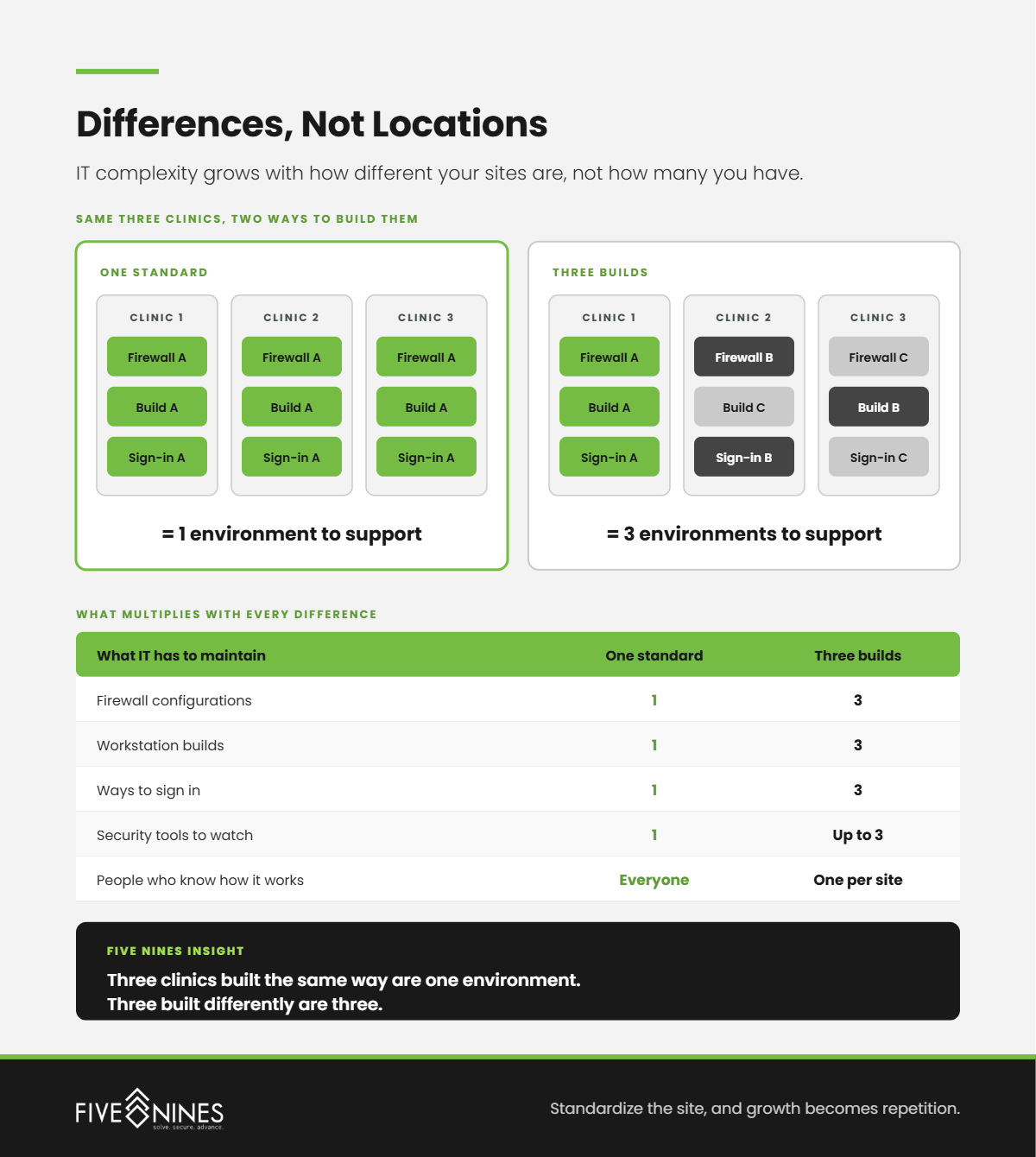
You keep IT from falling behind by deciding what every location looks like before the next one opens. Health systems lose control when each new clinic or acquired practice arrives with its own network, devices, logins, and security gaps. One standard, applied on day one, turns growth into repetition instead of reinvention.
Here is what falling behind looks like on the ground. The new clinic opens Monday. Check-in works, but the label printer only prints from one computer. Two providers still sign in to the old practice's email. Nobody knows who has the firewall password, and the practice's former IT vendor stopped answering at closing.
You did not acquire a practice. You acquired its IT history.
The pace is not slowing. A May 2026 report from Avalere Health for the Physicians Advocacy Institute found that hospitals, health systems, and other corporate entities acquired 13,900 more physician practices in 2024 and 2025. That brought their share to 64% of all U.S. practices, including 1,200 more rural practices. If your organization is part of that number, here is how Five Nines Technology Group approaches location growth for hospitals, health systems, and multi-site practices. For the broader picture of managed IT for growing organizations, see our guide to which managed IT services support growing healthcare organizations.
Why Does IT Fall Behind When a Health System Adds Locations?
Short answer: IT falls behind because growth gets planned around real estate, staffing, and clinical services, then handed to IT once the date is set. Each new clinic or acquired practice becomes a one-off project. One-off projects never add up to a standard, so every location ends up a little different, and the differences are what break.
The opening date gets set by the lease, the providers' start dates, and the payer credentialing calendar. IT usually gets the last few weeks. IT is not slow. It is scheduled last. The team buys whatever hardware ships in time, copies settings from the closest site, and lists the rest as cleanup.
Cleanup rarely happens, because the next location is already on the calendar. After a few rounds, the organization runs on a patchwork: different firewalls, different printers, different ways to sign in, and different people who know how each site works.
Most leadership teams read this as a staffing problem. It is not. It is a design problem. Adding IT staff to a patchwork gives you more people maintaining more versions of the same thing.
Five Nines Insight
IT complexity grows with the number of differences between your locations, not the number of locations.
What Happens When an Acquired Practice Keeps Its Old IT?
Short answer: An acquired practice that keeps its old IT keeps its old risks inside your network: unknown devices, former staff accounts, a previous vendor's remote access, and backups nobody has tested. Under HIPAA, those risks become the acquiring organization's to analyze and manage from the day the deal closes.
The devices are usually the first surprise. In a 2019 global survey of 2,779 IT and business decision makers, The Role of Cybersecurity in M&A Diligence by Forescout Technologies, 53% of IT decision makers said they find unaccounted for devices after completing the integration of an acquisition. In a medical practice, that list can include imaging workstations, lab interface computers, fax servers, and door access controllers.
The compliance exposure comes next. The HHS Office for Civil Rights runs a Risk Analysis Initiative focused on whether healthcare organizations keep an accurate and thorough HIPAA risk analysis. In its March 2025 settlement with Health Fitness Corporation, the corrective action plan included a process for evaluating environmental and operational changes that affect the security of ePHI. Adding a location is one of the largest operational changes a health system makes.
None of this makes acquisitions a mistake. It means the IT work starts before closing, not after.
The Hidden Risk
Access granted before closing does not expire at closing. Someone has to find it and remove it.
What Does an Acquisition's IT Actually Cost?
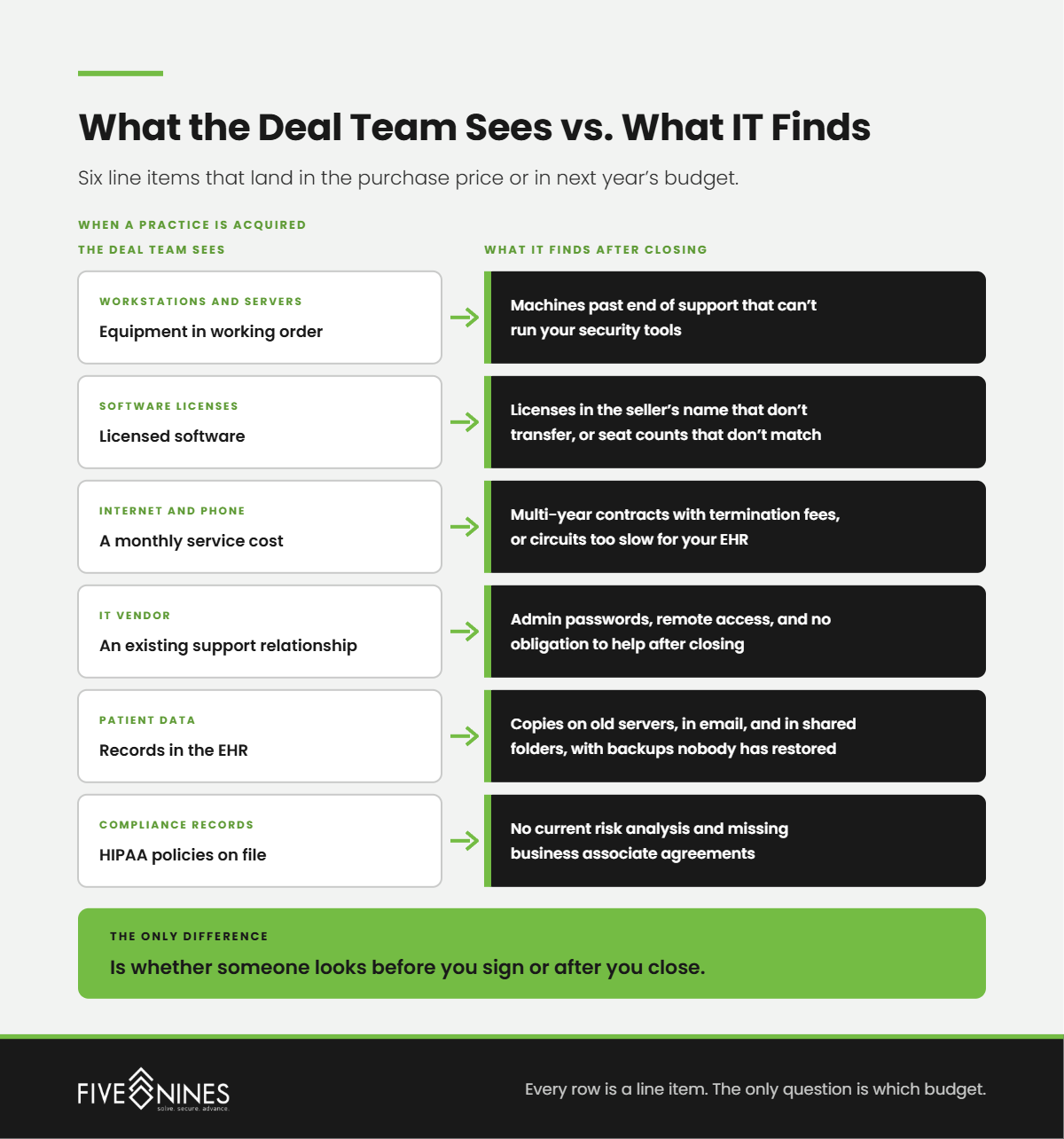
Short answer: The IT cost of an acquisition rarely shows up in the purchase price. It arrives after closing as replacement hardware, licenses that do not transfer, contracts with termination fees, and cleanup work nobody budgeted. Finding those items before signing turns post-close surprises into negotiating points.
|
Inherited item |
What the deal team sees |
What IT finds after closing |
|---|---|---|
|
Workstations and servers |
Equipment in working order |
Machines past end of support that cannot run your security tools and need replacing |
|
Software licenses |
Licensed software |
Licenses in the seller's name that do not transfer, or seat counts that do not match staff |
|
Internet and phone service |
A monthly service cost |
Multi-year contracts with termination fees, or circuits too slow for your EHR |
|
IT vendor |
An existing support relationship |
A vendor with admin passwords and remote access, and no obligation to help after closing |
|
Patient data |
Records in the EHR |
Copies on old servers, in email, and in shared folders, with backups nobody has restored |
|
Compliance records |
HIPAA policies on file |
No current risk analysis and missing business associate agreements |
For a CEO or CFO, every row is a line item. It lands in the purchase price or it lands in next year's operating budget. The only difference is when someone looks.
When Should IT Get Involved in a New Location or Acquisition?
Short answer: IT should be involved before the letter of intent is signed for an acquisition and before the lease is signed for a new site. The Five Nines Growth Readiness Gates tie four IT checkpoints to decisions leadership already makes, so IT is ready when the doors open instead of catching up afterward.
The Five Nines Growth Readiness Gates
|
Gate |
The question IT answers |
What it looks like on the floor if you skip it |
|---|---|---|
|
Gate 1: Before you sign |
What will it cost to bring this practice or site onto our standard? |
Remediation costs land after closing, in a budget that did not plan for them |
|
Gate 2: Before you close |
What do we own, who has access, and how do we cut over? |
Former staff and the old vendor keep access past closing day |
|
Gate 3: Before you open |
Does the site match our day-one standard? |
The front desk invents workarounds in week one |
|
Gate 4: Before the next one |
What did this site teach the playbook? |
The next opening repeats the same problems |
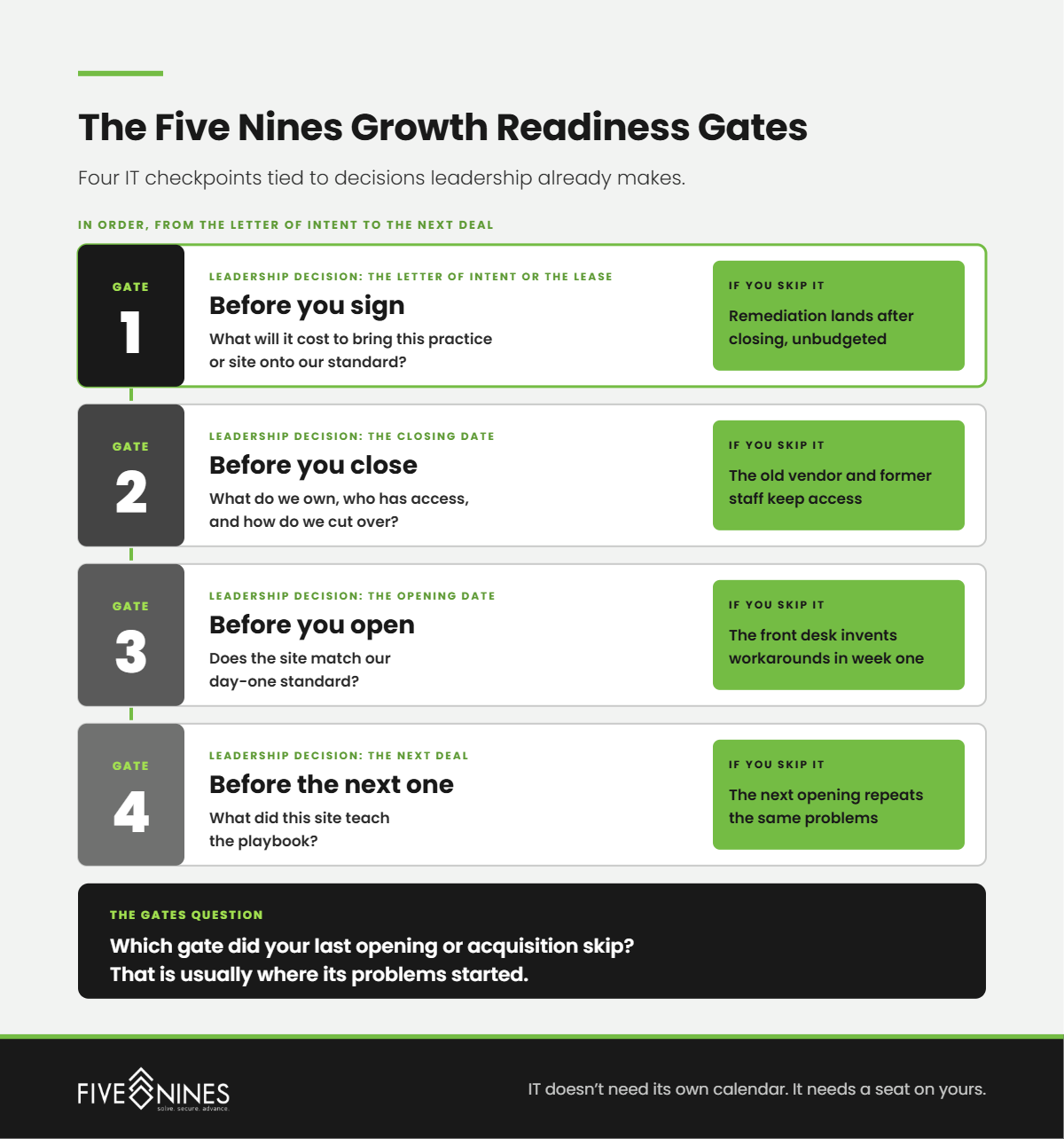
Each gate sits beside a decision leadership already makes: the letter of intent, the closing date, the opening date, and the next deal. That is the point. IT does not need its own calendar. It needs a seat on the one you already have.
Gate 3 is where the day-one standard lives: the same network design, the same sign-in with MFA, managed and monitored devices, tested EHR workflows and peripherals, posted downtime procedures, and one help desk number staff already know. For how to build that standard across the clinics you already run, see our guide to standardizing IT across a multi-location medical group.
Five Nines IT Strategy and Consulting covers Gates 1 and 2 through M&A IT due diligence and integration planning. Five Nines Managed IT carries Gates 3 and 4, from opening day forward.
What Leadership Misses
A clinic that works on opening day but looks different from every other site is not finished. It is next quarter's ticket queue.
What Does Five Nines Usually Find When a Practice Joins a Health System?
Short answer: When an independent practice joins a larger organization, Five Nines engineers tend to find gaps no purchase agreement mentions: accounts registered to individuals instead of the business, one undocumented computer that runs something critical, contracts that renewed themselves, and building systems sitting on the clinical network.
- The domain in someone's name. The practice's website, email domain, or EHR admin account is registered to a former office manager or a physician's personal email.
- The one critical computer. A single workstation quietly runs the lab interface, fax server, or imaging bridge, and nobody wrote down that it matters.
- The contract that renewed itself. Internet, phone, or copier agreements auto-renewed in the practice's name and surface only at cutover.
- The circuit that sets the opening date. A new site's internet service was ordered late, so the clinic either waits or opens on a temporary connection.
- The building systems nobody counted. Door access, cameras, and HVAC controls installed by a landlord or prior tenant share the network with EHR workstations.
What Should You Ask an IT Provider Before Your Next Location Opens?
Short answer: Ask whether the provider can price an acquisition's IT before you sign, how fast it removes former owner and vendor access, how much notice it needs before an opening, and when a new site enters security monitoring. Vague answers to those four questions predict a patchwork.
- Can you do IT due diligence on a practice before we sign the letter of intent?
- Will you put a cost estimate on bringing an acquired site up to our standard?
- How quickly can you remove the former owner's accounts and vendor access at closing?
- How much notice do you need before a new lease to have the site ready on opening day?
- When does a new site appear in your security monitoring: opening day, or after migration?
- Who on your team joins our deal and real estate planning conversations?
How Many Versions of IT Are Your Locations Running?
If every new clinic feels like starting over, the problem is not your team's effort. It is the missing standard underneath it.
A Five Nines Multi-Location IT Readiness Review identifies:
- Where your locations differ in network design, devices, sign-in, and security tools
- Accounts and vendor access left over from past acquisitions
- Devices that are not managed, monitored, or documented
- Gaps in your HIPAA risk analysis tied to new or acquired sites
- Which Five Nines Growth Readiness Gates your last opening or acquisition skipped
You leave with a location-by-location scorecard and a written day-one standard for your next opening or acquisition.
Growth should feel like repetition, not reinvention.